1. Introduction
Geomembranes are core impermeable geosynthetic materials widely applied in modern industrial projects, serving as critical barrier systems for liquid containment, pollution prevention, foundation protection, and environmental isolation. From industrial wastewater ponds, chemical storage tanks, and mining tailings ponds to landfill liners and oil & gas site anti-seepage projects, high-quality geomembranes ensure project safety, long-term stability, and environmental compliance. Unlike conventional civil materials, industrial-grade geomembranes feature low permeability, excellent chemical resistance, superior mechanical performance, and long service life, which directly determines the operational lifespan, maintenance cost, and environmental risk control level of industrial facilities.
However, improper geomembrane selection is one of the leading causes of industrial project failures, including leakage, membrane cracking, chemical corrosion, and subgrade settlement damage. Each industrial scenario has unique requirements for material properties, thickness, surface texture, and installation adaptability. This ultimate guide systematically elaborates on core selection principles, mainstream material types, key performance indicators, scenario-based selection strategies, and practical case analysis, helping engineers and project investors select the most cost-effective and reliable geomembrane solutions for industrial projects.
2. Core Functions of Industrial-Grade Geomembranes
Industrial geomembranes differ greatly from civilian and agricultural-grade products, with functional design fully oriented to harsh industrial operating conditions. Their core functions cover three key dimensions:
2.1 Impermeable Barrier
As the most fundamental function, ultra-low water and gas permeability effectively isolates industrial wastewater, chemical leachate, toxic liquids, and polluted soil, preventing groundwater and soil contamination. Qualified industrial geomembranes can maintain stable impermeable performance under long-term hydraulic pressure and temperature changes, avoiding persistent environmental pollution risks.
2.2 Structural Protection & Stress Resistance
Industrial sites often face complex subgrade conditions, differential settlement, mechanical extrusion, and slope tension. High-performance geomembranes can resist puncture, tensile damage, and stress cracking, protecting project foundations from structural damage and improving the overall stability of containment systems.
2.3 Chemical & Environmental Durability
Industrial environments involve corrosive media such as acids, alkalis, salts, and organic hydrocarbons. Professional industrial geomembranes maintain stable physical and chemical properties under long-term chemical erosion, UV radiation, high and low temperature alternation, avoiding aging, brittle fracture, and performance attenuation.
3. Mainstream Geomembrane Material Types & Industrial Adaptability
Different geomembrane materials have distinct performance advantages and applicable scenarios. Mastering the characteristics of mainstream materials is the primary premise of scientific selection. The three most widely used industrial geomembrane types are HDPE, LLDPE, and PVC geomembranes.
3.1 HDPE (High-Density Polyethylene) Geomembrane
HDPE geomembrane is the most dominant industrial-grade liner material in the global market, meeting ASTM international industry standards. It features ultra-high chemical resistance, excellent tensile strength, low permeability, and outstanding aging resistance. With a service life of more than 50 years in underground protected environments and 20–30 years in exposed industrial scenarios, it is suitable for high-standard and long-life industrial projects.
Advantages: Resistant to most acids, alkalis, salts, and organic solvents; strong structural stability; low water vapor permeability; mature welding construction process; high overall project safety.
Disadvantages: Relatively stiff texture, poor adaptability to severely uneven subgrades, prone to stress cracking with low-quality formulations.
Best Industrial Applications: Municipal and industrial landfills, mining tailings ponds, hazardous chemical storage ponds, high-pollution wastewater treatment projects, potable water industrial storage facilities.
3.2 LLDPE (Linear Low-Density Polyethylene) Geomembrane
LLDPE geomembrane is optimized for flexibility and deformation resistance, with an elongation at break exceeding 800% (compliant with ASTM D6693 standard), far higher than HDPE materials. It can adapt to subgrade differential settlement, irregular foundation surfaces, and dynamic load changes, effectively avoiding cracking and leakage caused by ground deformation.
Advantages: Excellent flexibility and stress crack resistance; strong puncture resistance; easy construction on complex terrains; good low-temperature toughness.
Disadvantages: Slightly lower chemical resistance and structural strength than HDPE; higher long-term aging attenuation in strong UV exposure environments.
Best Industrial Applications: Industrial temporary containment projects, sites with frequent subgrade settlement, irregular slope structures, low-corrosion wastewater ponds, cold-region industrial anti-seepage projects.
3.3 PVC (Polyvinyl Chloride) Geomembrane
PVC geomembrane is a cost-effective lightweight anti-seepage material with good flexibility and convenient construction. Its service life is 10–15 years in exposed industrial environments, suitable for short-term and medium-low standard industrial projects.
Advantages: Low initial cost; soft texture; good ductility; convenient cutting and laying.
Disadvantages: Poor resistance to high-concentration chemical corrosion; weak UV aging resistance; easy hardening and embrittlement in long-term high-temperature environments.
Best Industrial Applications: Temporary industrial water storage, low-corrosion circulating water ponds, auxiliary industrial facility anti-seepage, short-term construction containment projects.
4. Key Selection Factors for Industrial Geomembranes
Industrial geomembrane selection cannot rely solely on material types. It is necessary to comprehensively evaluate project conditions, environmental parameters, and engineering requirements from six core dimensions to avoid one-sided selection errors.
4.1 Chemical Compatibility
Chemical compatibility is the top priority for industrial project selection. Different industrial waste liquids, leachates, and chemical raw materials have different corrosive properties. For projects involving strong acid, strong alkali, and organic hydrocarbon media, HDPE geomembrane must be prioritized due to its excellent comprehensive chemical resistance. For low-corrosion water-based industrial wastewater, LLDPE and high-quality PVC materials can meet the requirements. It is necessary to conduct a chemical compatibility test before formal selection to ensure the material will not swell, crack, or degrade in long-term contact with industrial media.
4.2 Site Topography & Mechanical Stress
Complex site conditions put forward clear mechanical performance requirements for geomembranes. For industrial projects with steep slopes (gradient greater than 3:1), textured geomembranes must be selected to increase the interface friction angle above 20°, preventing sliding and landslide risks of the liner system. For sites with loose subgrade and frequent differential settlement, high-elongation LLDPE geomembranes are preferred to resist tensile deformation. For flat and stable foundation projects, standard HDPE geomembranes can meet structural stability requirements.
4.3 Geomembrane Thickness Matching
Thickness directly determines the mechanical strength, anti-puncture ability, and service life of the geomembrane, but thicker is not always better. The thickness must match the project load and application scenario:
- 0.5mm–1.0mm: Light-duty industrial applications, such as temporary industrial water storage, low-load auxiliary facility anti-seepage
- 1.5mm–2.0mm: Medium-duty industrial projects, including conventional industrial wastewater ponds, general chemical containment, flat-site anti-seepage
- 2.0mm–3.0mm: Heavy-duty industrial projects, such as mining tailings ponds, hazardous waste landfills, high-pressure containment systems, steep-slope industrial facilities
4.4 Environmental Adaptability
Outdoor industrial projects exposed to long-term sunlight must select UV-stabilized geomembranes to avoid aging and performance degradation. High-temperature industrial sites require materials with high-temperature resistance and low thermal shrinkage; cold-region projects need low-temperature tough geomembranes to prevent brittle fracture in low-temperature environments. Underground buried geomembranes can appropriately reduce UV resistance requirements but need higher stress crack resistance.
4.5 Industry Certification & Quality Standards
Qualified industrial geomembranes must comply with international authoritative standards such as ASTM D6693, ASTM D5199, and national industrial engineering specifications. It is necessary to verify product test reports, anti-aging performance parameters, and environmental certification documents. Uncertified low-cost products often have unstable tensile strength, poor impermeability, and short service life, leading to huge hidden dangers for industrial project operation.
4.6 Construction & Maintenance Cost
While focusing on performance, the overall life-cycle cost should be considered. HDPE geomembranes have high initial investment but ultra-long service life and low later maintenance cost, suitable for permanent industrial projects. LLDPE geomembranes have moderate cost and strong adaptability, suitable for complex terrain projects. PVC geomembranes have low initial cost but frequent replacement, only applicable for short-term temporary projects.
5. Practical Industrial Project Case Analysis
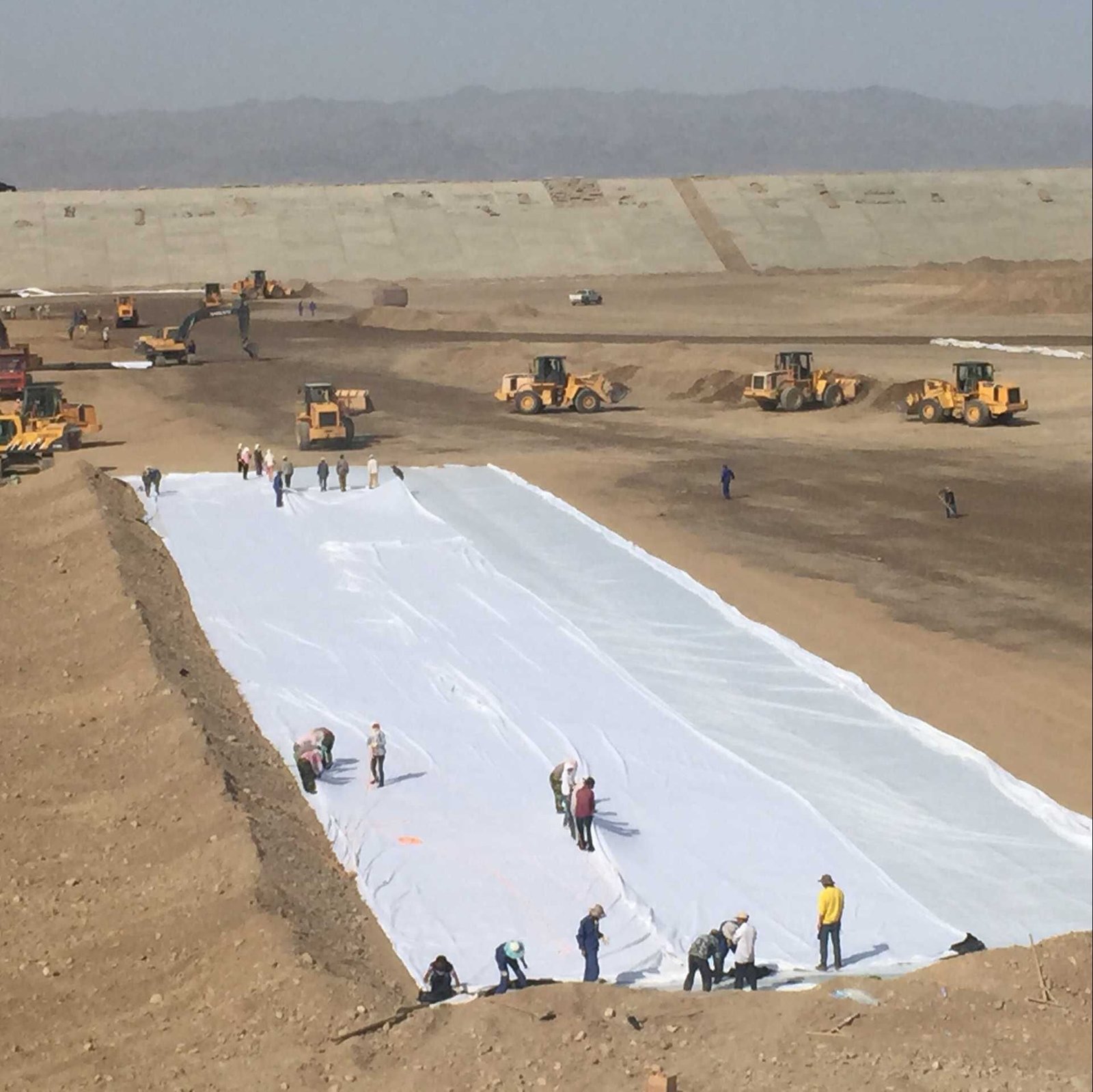
5.1 Case 1: Mining Tailings Pond Anti-Seepage Project
Project Background: A large metal mining enterprise built a tailings pond, which needs long-term anti-seepage treatment for tailings leachate containing heavy metals and weak acid substances, with a design service life of 50 years, complex slope terrain, and certain subgrade settlement risks.
Selection Scheme: 2.0mm textured HDPE geomembrane
Selection Reason: HDPE material has excellent resistance to heavy metal leachate and weak acid corrosion, meeting long-term anti-corrosion and impermeability requirements; textured surface increases slope friction to prevent sliding; 2.0mm thickness provides sufficient puncture and tensile resistance to adapt to tailings stacking pressure and slight subgrade settlement.
Project Effect: After 8 years of operation, no leakage, cracking, or corrosion occurred in the geomembrane system, and the groundwater and soil environment around the project remained stable, meeting environmental protection and industrial operation standards.
5.2 Case 2: Industrial Park Wastewater Treatment Pond Project
Project Background: A comprehensive industrial park’s domestic and conventional industrial wastewater pond, with flat terrain, low corrosive water quality, occasional small-scale subgrade deformation, and design service life of 25 years.
Selection Scheme: 1.5mm smooth LLDPE geomembrane
Selection Reason: LLDPE’s high elongation performance adapts to occasional subgrade settlement and deformation, avoiding membrane cracking; it has good resistance to conventional wastewater corrosion, with moderate cost and high cost performance; smooth surface is convenient for cleaning and daily maintenance of the wastewater pond.
Project Effect: The project has been operating stably for 5 years, with zero leakage, low maintenance frequency, and effectively reducing the operational cost of the park’s environmental protection system.
6. Common Selection Mistakes & Avoidance Strategies
- Mistake 1: Blindly pursuing low cost: Many projects choose low-priced unqualified geomembranes to save initial investment, resulting in early aging, leakage, and repeated maintenance, which greatly increases the overall life-cycle cost. Avoidance: Prioritize certified industrial-grade products and evaluate comprehensive life-cycle benefits rather than single purchase cost.
- Mistake 2: Uniform material selection for all scenarios: Using HDPE for all complex terrain projects or PVC for long-term industrial projects leads to poor adaptability and premature failure. Avoidance: Match materials according to chemical media, terrain conditions, and service life requirements.
- Mistake 3: Ignoring thickness matching: Excessively thin membranes cannot resist industrial load pressure, while excessively thick membranes cause cost waste. Avoidance: Select thickness strictly based on project load, slope gradient, and containment medium characteristics.
- Mistake 4: Neglecting construction adaptability: Stiff HDPE membranes are forcibly laid on severely uneven subgrades, causing hidden cracking dangers. Avoidance: Adjust material flexibility and surface type according to site construction conditions.
7. Conclusion
Geomembrane selection is a systematic engineering work that runs through the whole life cycle of industrial projects, directly affecting project safety, environmental compliance, and economic benefits. The core of scientific selection is to match the most suitable material, thickness, and surface type according to the project’s chemical medium characteristics, site terrain, mechanical stress, service life requirements, and environmental conditions.
In permanent high-pollution and high-standard industrial projects, UV-stabilized thickened HDPE geomembranes are the most reliable choice; in complex terrain and deformation-sensitive projects, high-flexibility LLDPE geomembranes can maximize project stability; in short-term low-load temporary projects, qualified PVC geomembranes can achieve optimal cost performance. By avoiding common selection mistakes and adhering to industry standard specifications, enterprises can build durable, safe, and low-maintenance industrial anti-seepage systems, effectively controlling environmental risks and creating long-term economic and environmental value for industrial projects.