HDPE membrane sheets, also known as high-density polyethylene geomembrane sheets or liners, are continuous thermoplastic barriers manufactured from virgin high-density polyethylene resin with a formulated density of ≥ 0.940 g/cm³. Blended with 2.0–3.0 % carbon black and antioxidants, these sheets deliver extremely low permeability (typically ≤ 1 × 10⁻¹¹ to 1 × 10⁻¹³ cm/s per ASTM D5887), exceptional chemical resistance, high tensile and puncture strength, and multi-decade durability under GRI-GM13 standards. They are the preferred material for landfill primary liners, mining heap-leach pads, industrial containment ponds, water reservoirs, canals, and secondary containment systems worldwide.
In 2026, HDPE membrane sheets continue to dominate the geomembrane market, holding approximately 60 % share of a sector valued at over USD 2.6 billion and projected to grow steadily. Their combination of impermeability, mechanical robustness, UV stability, and reliable field weldability makes them indispensable for projects requiring long-term environmental protection. This comprehensive review evaluates the ten best HDPE membrane sheets available, focusing on quantifiable metrics including tensile strength, puncture resistance, thickness consistency, certifications, and field performance. Special emphasis is placed on the Smooth HDPE Geomembrane Liner manufactured by The Project Material Co., Ltd. (BPM Geosynthetics). Other Chinese manufacturers are excluded from this assessment.
Understanding HDPE Membrane Sheets – Core Properties and Standards
HDPE membrane sheets function as impermeable barriers that prevent fluid and gas migration. Key performance attributes include:
- Hydraulic conductivity as low as 1 × 10⁻¹³ cm/s
- Tensile strength that scales with thickness (yield 11–44 kN/m; break 20–80 kN/m across 0.75–3.0 mm)
- Puncture resistance from 240 N (0.75 mm) to 960 N (3.0 mm)
- Elongation at break ≥ 700 %
- Stress-crack resistance ≥ 500 hours (ASTM D5397)
- Carbon-black content 2.0–3.0 % with Category 1 or 2 dispersion
- Standard OIT ≥ 100 min and high-pressure OIT commonly ≥ 400 min
The GRI-GM13 standard governs commercial HDPE membrane sheets in the 0.75–3.0 mm (30–120 mil) thickness range, specifying minimum average roll values, test methods, and testing frequencies. Compliance with GRI-GM13 provides a defensible, internationally recognized baseline for quality and performance.
Why HDPE Membrane Sheets Excel in Containment Applications
Compared with clay liners, HDPE membrane sheets reduce seepage by up to 95 % while lowering construction costs by 20–30 %. They resist a wide range of acids, alkalis, and hydrocarbons, maintain integrity under differential settlement when properly designed, and offer service lives of 50–100 years when buried. Thickness selection balances mechanical demands, chemical exposure, overburden pressure, and budget: 1.5 mm (60 mil) remains the most common specification for primary landfill liners and many mining applications.
The Top 10 HDPE Membrane Sheets – 2026 Detailed Review
1. Solmax HDPE Membrane Sheets (Canada / Global)
Solmax produces high-volume HDPE membrane sheets that meet or exceed GRI-GM13 across the full thickness spectrum. Typical 1.5 mm grades deliver tensile break strengths of 40–80 kN/m and puncture resistance of 480–1 000 N or higher. Density ≥ 0.940 g/cm³ and controlled carbon-black dispersion ensure UV and oxidative stability. Wide rolls up to 10 m reduce field seams. High-pressure OIT ≥ 400 min supports long service life. Smooth, textured, conductive, and white-surfaced options are available. Solmax’s estimated tens of thousands of tons of annual HDPE capacity and extensive project references position it as a global volume leader. Major clients include international mining corporations, municipal solid-waste authorities, and large EPC contractors. Certifications include GRI-GM13, ISO 9001/14001, and GAI-LAP.
2. AGRU HDPE Membrane Sheets (Austria / USA)
AGRU’s flat-die extrusion technology delivers exceptional thickness uniformity (±5 % or better). HDPE membrane sheets in 0.75–3.0 mm thicknesses provide high tensile properties and stress-crack resistance well above the 500-hour minimum. Puncture resistance frequently exceeds 500–1 600 N in heavier gauges. High-pressure OIT ≥ 400 min. Roll widths up to 10.5 m further minimize seams. AGRU sheets are valued for precision performance in industrial containment, reservoirs, and slope applications. Clients include hazardous-waste facilities, industrial operators, and water authorities. Certifications encompass GRI-GM13, ISO 9001, CE, and relevant NSF listings.
3. GSE HDPE Membrane Sheets (Legacy under Solmax)
GSE HDPE membrane sheets retain a multi-decade North American track record in landfill and industrial containment. Standard 1.5 mm grades typically achieve tensile yield ≥ 22 kN/m, break ≥ 40 kN/m, puncture ≥ 480 N, and elongation ≥ 700 %. Density and carbon-black formulations meet GRI-GM13. Field performance from hundreds of millions of square meters installed demonstrates reliable long-term impermeability. Welding characteristics align with standard hot-wedge parameters, delivering seam strengths of 85–98 % of parent material.
4. NAUE Carbofol HDPE Membrane Sheets (Germany)
NAUE supplies high-durability HDPE membrane sheets, frequently integrated into composite liner systems. Thicknesses typically 1.0–2.5 mm deliver robust tensile and puncture values consistent with GRI-GM13. Wide rolls (up to 9.4 m) and European certifications (ISO, CE, BAM/DIBt) support infrastructure and environmental projects. Emphasis is placed on chemical resistance and long-term performance under European regulatory frameworks. Major clients include European waste, water, and civil-engineering authorities.
5. Atarfil HDPE Membrane Sheets (Spain)
Atarfil manufactures HDPE membrane sheets using advanced extrusion that ensures thickness consistency and elevated environmental stress-crack resistance. Products in the 0.75–3.0 mm range satisfy GRI-GM13 mechanical requirements. Roll widths up to 10 m reduce installation seams on large cells. High-pressure OIT and UV performance support both covered and temporarily exposed applications. Certifications include GRI standards, CE, and ISO. The brand maintains strong positions in European, Latin American, and selected global landfill and mining markets.
6. Layfield HDPE Membrane Sheets (Canada)
Layfield offers HDPE membrane sheets from 0.75–2.5 mm with tensile and puncture values aligned with GRI-GM13. The products are widely specified in North American municipal, agricultural, and industrial containment. Density ≥ 0.940 g/cm³, carbon-black content 2–3 %, and stress-crack resistance ≥ 500 h are standard. Fabrication capabilities support large-panel delivery, reducing field welding. Certifications follow ASTM and GRI protocols. Clients include Canadian and U.S. waste, water, and resource companies seeking reliable technical support.
7. Specialty Textured HDPE Membrane Sheets
Textured HDPE membrane sheets (single- or double-sided) provide elevated interface friction for steep slopes and cover systems. Asperity height typically meets or exceeds 0.25 mm. While tensile and elongation values are modestly lower than smooth equivalents due to texturing, the products still satisfy GRI-GM13 requirements for textured sheet and deliver superior slope stability. These grades are essential for projects where interface shear strength is critical.
8. Conductive / Leak-Detection Enhanced HDPE Membrane Sheets
Specialized HDPE membrane sheets incorporating conductive layers enable electrical leak-location surveys after installation. Mechanical properties remain GRI-GM13 compliant while adding the ability to verify liner integrity non-destructively. These variants are increasingly specified on high-consequence projects where post-installation quality assurance is critical.
9. Premium High-Stress-Crack-Resistance HDPE Membrane Sheets
Selected specialty producers offer HDPE membrane sheets formulated for elevated stress-crack resistance (often well above 500–1 000 hours). These products maintain full GRI-GM13 compliance while providing additional margin in applications subject to long-term tensile stress or aggressive chemical environments.
10. BPM Smooth HDPE Membrane Sheets (The Project Material Co., Ltd. / BPM Geosynthetics)
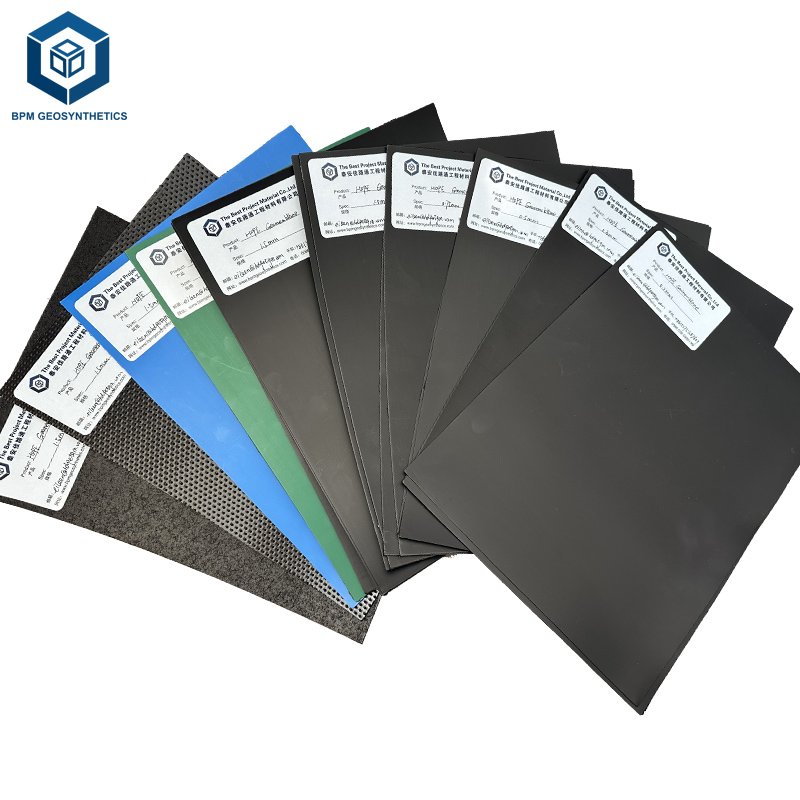
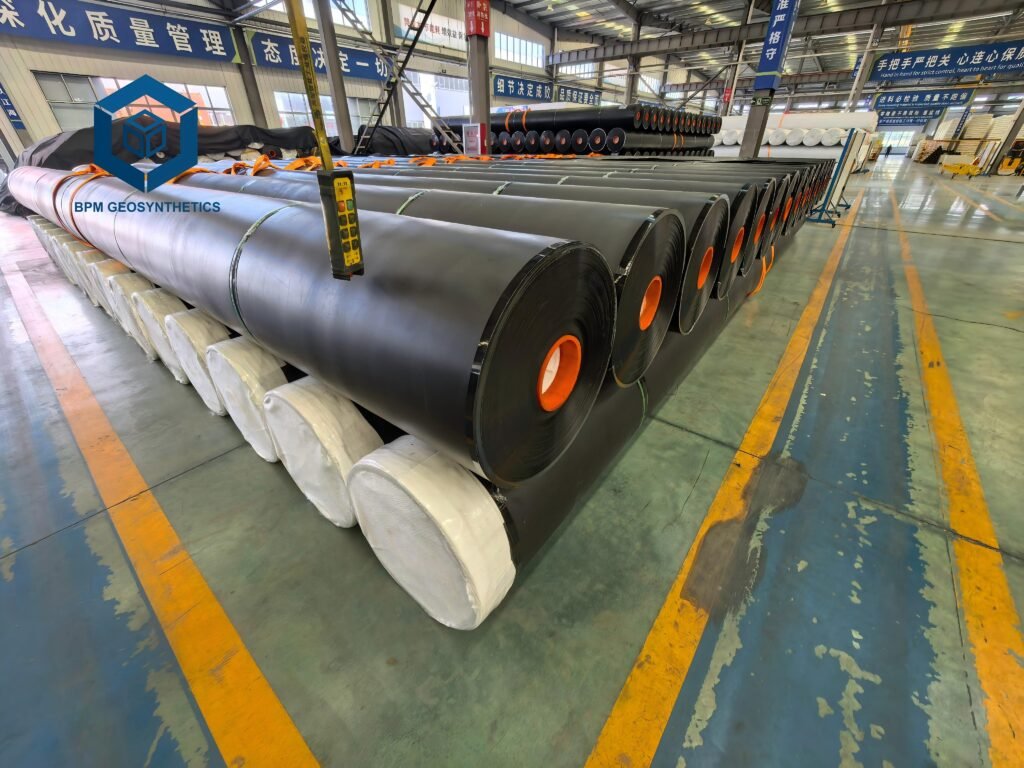
BPM’s Smooth HDPE Membrane Sheets are manufactured from virgin resin with 2.0–3.0 % premium carbon black. Available in thicknesses from 0.5 mm to 3.0 mm, typical properties for a 1.5 mm grade include density 0.94 g/cm³, tensile yield strength 22 kN/m, break strength 40 kN/m, elongation ≥ 700 %, tear resistance 187 N, puncture resistance 480 N (scaling to 960 N at 3.0 mm), stress-crack resistance ≥ 500 h, and high-pressure OIT ≥ 400 min. Permeability is typically ≤ 1 × 10⁻¹¹ cm/s or lower. Roll widths of approximately 7 m and tight thickness tolerance facilitate high-quality hot-wedge welding. The product fully complies with GRI-GM13, ISO 9001, and CE requirements and is supplied with comprehensive third-party test reports. BPM sheets have been installed in municipal solid-waste, hazardous-waste, mining, industrial, agricultural, and water-containment projects across more than 80 countries, delivering consistent field weld performance and reliable long-term impermeability.
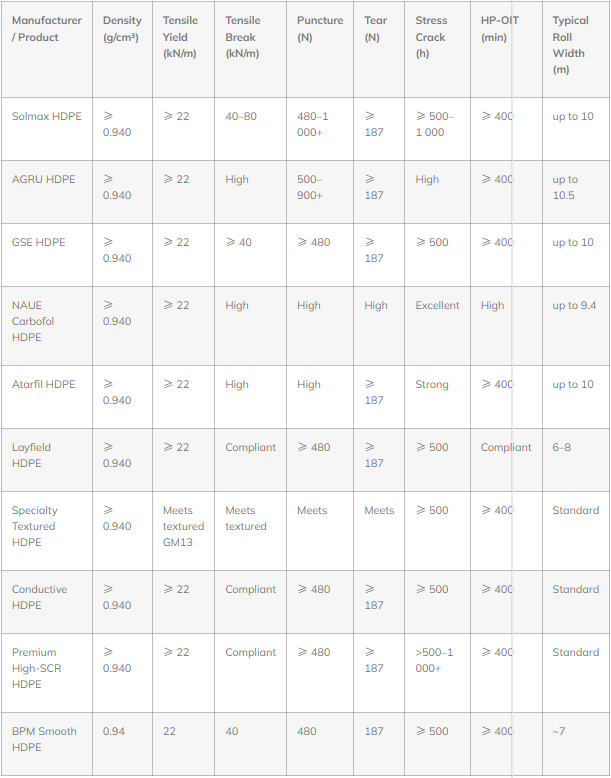
Comparison Table 1 – Core Technical Parameters of Leading HDPE Membrane Sheets (Typical 1.5 mm Smooth Grades)
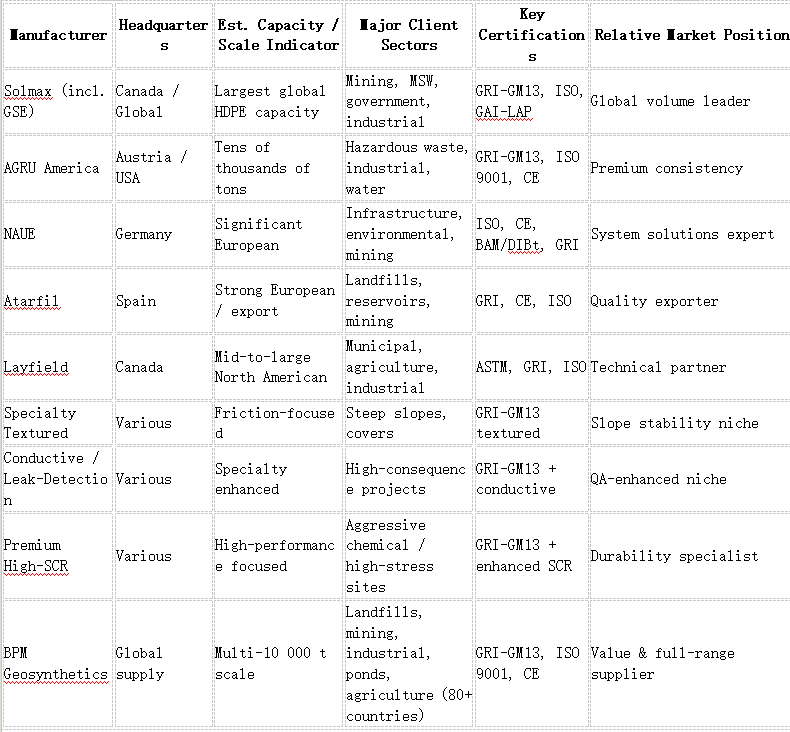
Comparison Table 2 – Market Position, Scale, Clients and Certifications
Installation, Welding and Quality Assurance for HDPE Membrane Sheets
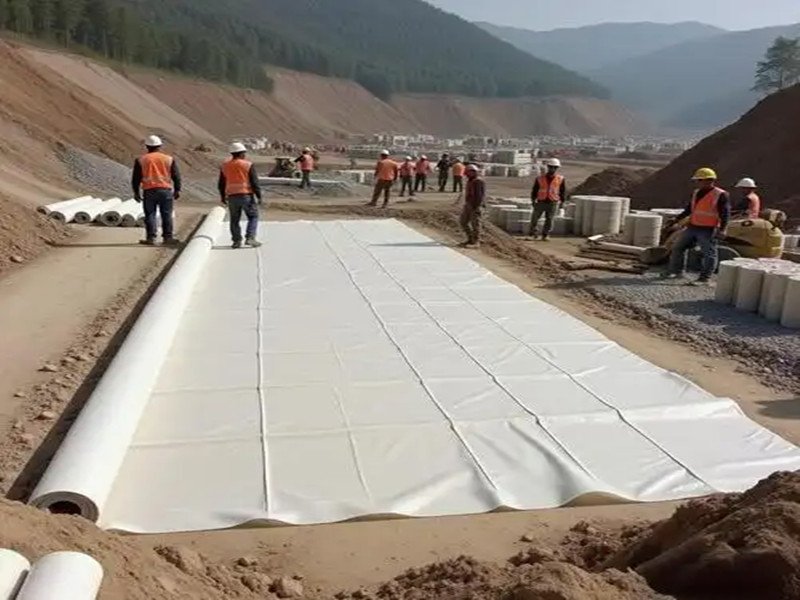
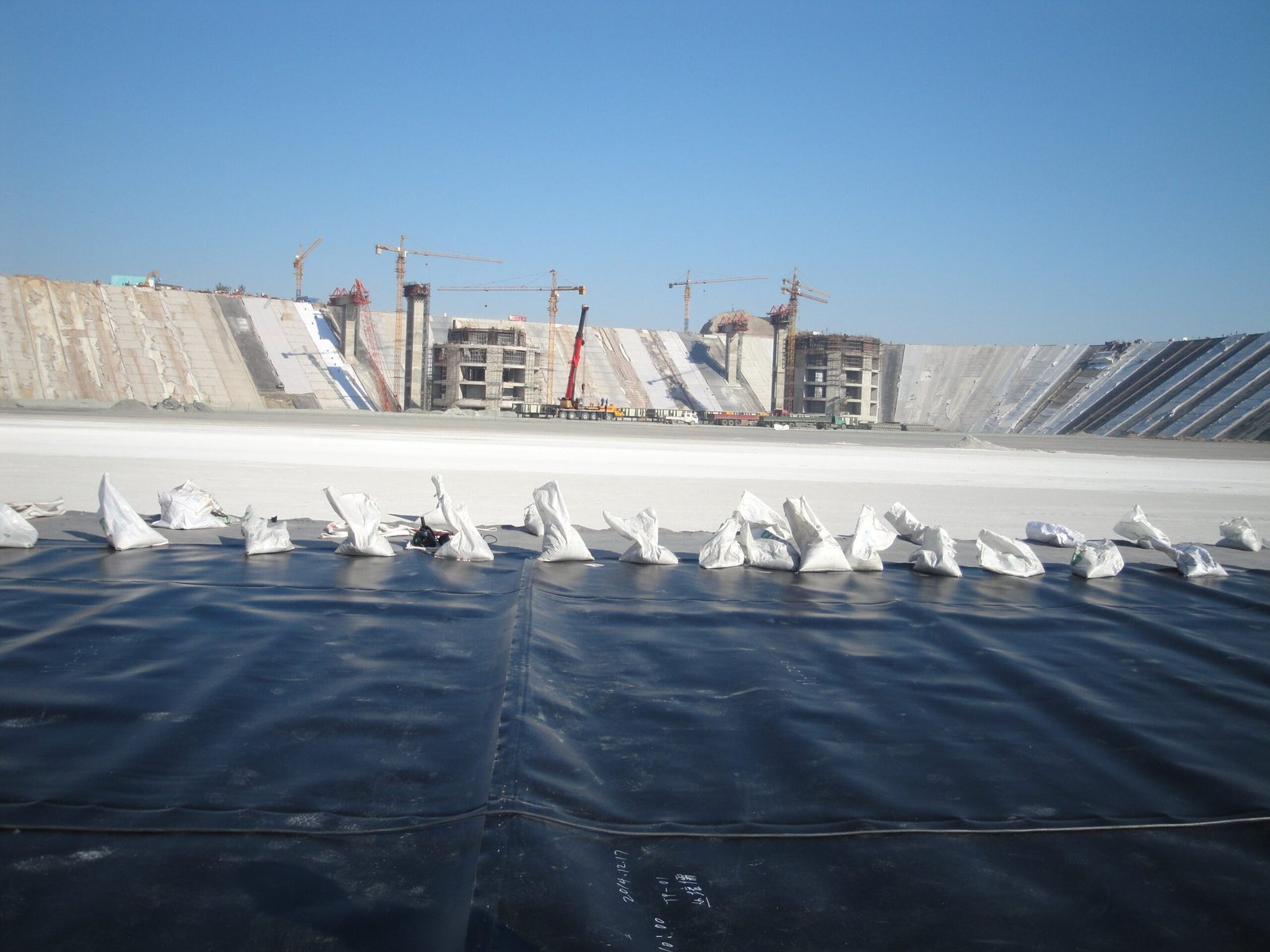
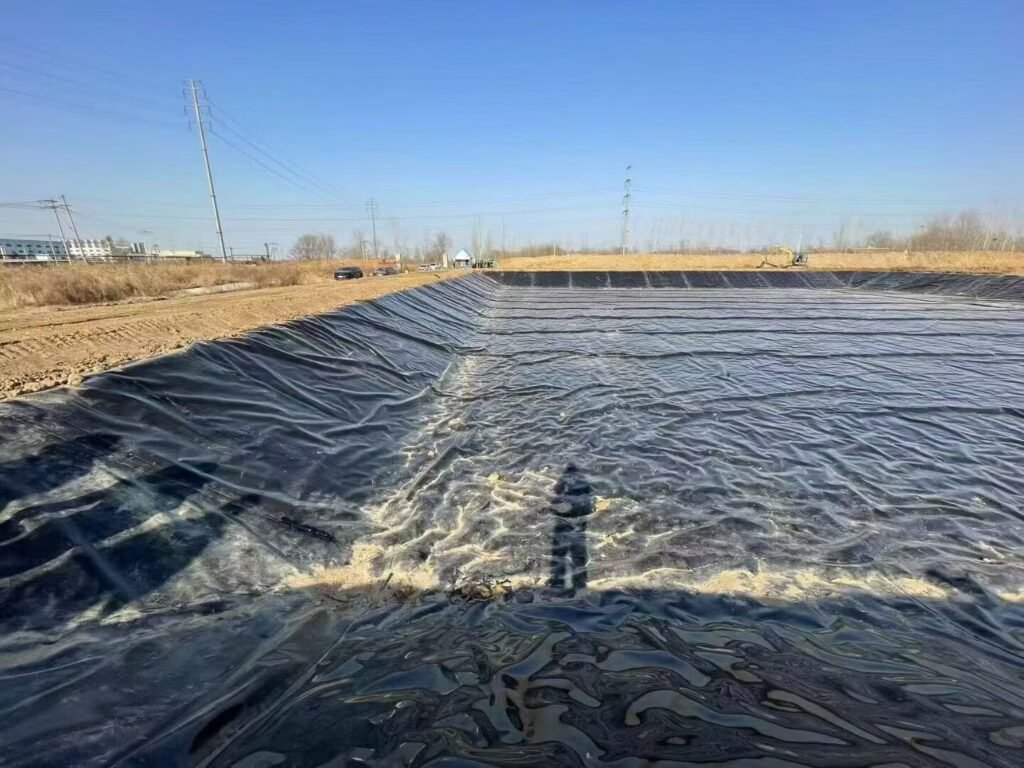
HDPE membrane sheets are primarily joined by hot-wedge welding. Typical parameters for common thicknesses fall in the range of 380–450 °C with travel speeds adjusted to produce dual-track seams whose strength exceeds 85–98 % of parent material. Extrusion welding is used for detail work, repairs, and penetrations. Proper subgrade preparation is essential: the surface should be free of sharp objects, and a protective non-woven geotextile is recommended under moderate-to-high puncture-risk conditions. Non-destructive air-channel testing of dual-track seams and destructive seam sampling form the foundation of construction quality-assurance programs. Electrical leak-location surveys are increasingly specified on conductive sheets for post-installation verification.
BPM Geosynthetics Advantages in HDPE Membrane Sheet Supply
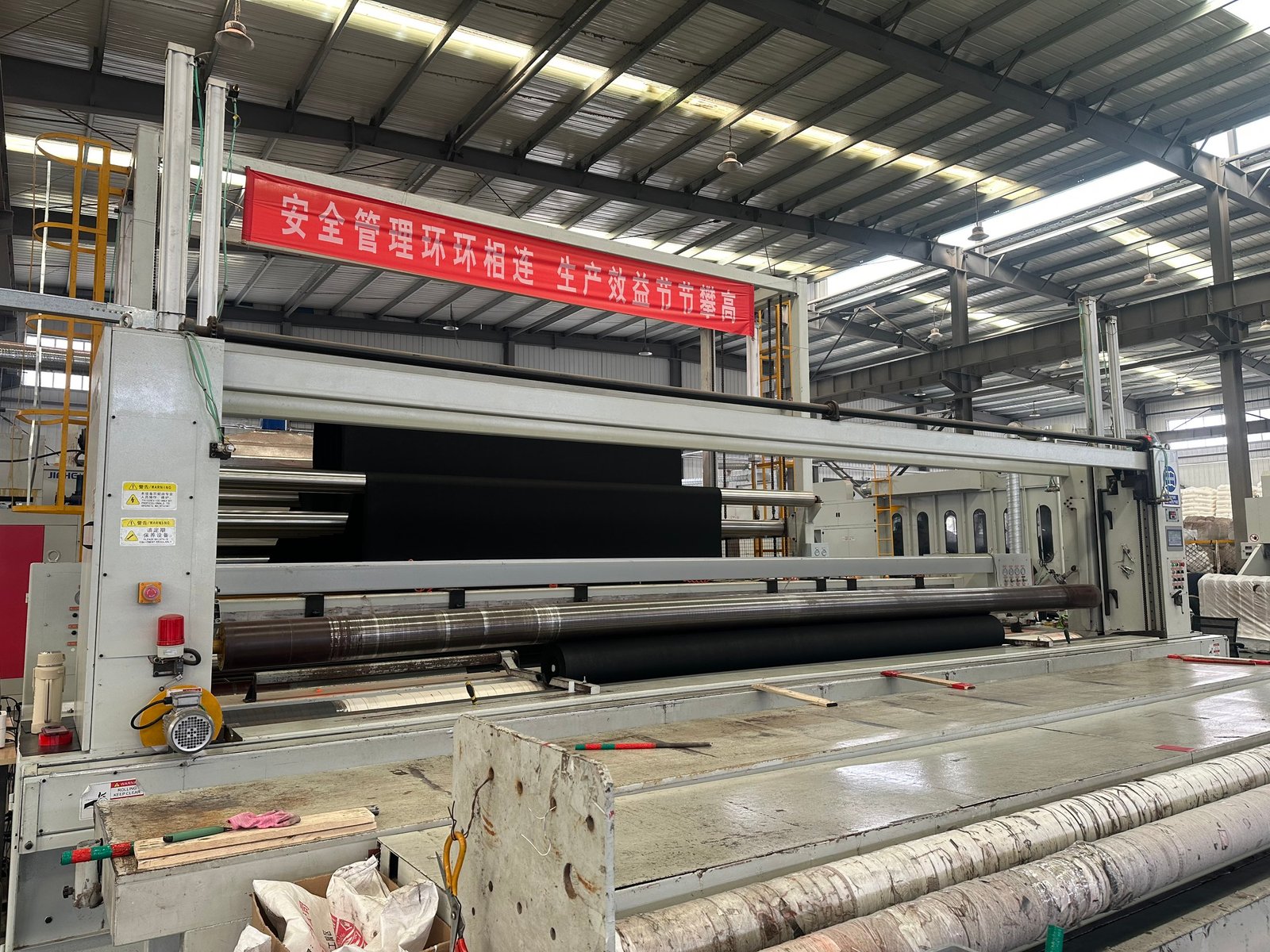
The Project Material Co., Ltd. (BPM Geosynthetics) manufactures Smooth HDPE Membrane Sheets from virgin resin under controlled extrusion conditions. The resulting product meets full GRI-GM13 requirements across the 0.5–3.0 mm thickness range. For a representative 1.5 mm grade, properties include density 0.94 g/cm³, tensile yield strength 22 kN/m, break strength 40 kN/m, elongation ≥ 700 %, tear resistance 187 N, puncture resistance 480 N (scaling to 960 N at 3.0 mm), stress-crack resistance ≥ 500 h, and high-pressure OIT ≥ 400 min. Permeability remains extremely low, typically ≤ 1 × 10⁻¹¹ cm/s or better.
Approximately 7 m roll widths reduce the number of field seams, lowering both installation time and potential leak paths. Thickness tolerance is maintained within industry best-practice limits, ensuring consistent welding behavior. Full third-party laboratory documentation, ISO 9001 quality systems, and CE marking provide the traceability demanded by international specifications and project financiers.
BPM’s production capacity supports medium and large contracts with competitive pricing and reliable delivery. Field weld success rates and long-term performance data from projects in more than 80 countries demonstrate that BPM HDPE membrane sheets deliver the mechanical robustness, chemical resistance, impermeability, and durability expected of premium GRI-GM13-compliant products at a value-oriented cost structure.
Engineers and project owners select BPM HDPE membrane sheets when they require a proven balance of strength, chemical resistance, weldability, documentation, and economic efficiency—particularly for primary landfill liners, heap-leach pads, industrial containment, and large water-storage projects where long-term integrity is paramount.
Application Suitability and Design Guidance
HDPE membrane sheets are preferred for:
- Primary and secondary landfill liners under Subtitle D and equivalent regulations
- Mining heap-leach pads, process ponds, and tailings facilities
- Industrial process-water and wastewater lagoons
- Secondary containment for chemicals and fuels
- Large water reservoirs, irrigation canals, and agricultural ponds requiring multi-decade service life
- High-overburden or moderate equipment-traffic areas
Designers should confirm that the selected product’s tensile, puncture, stress-crack, and permeability values meet project-specific requirements, that roll widths minimize seams, and that the manufacturer supplies complete GRI-GM13 conformance documentation. Protective geotextiles, proper subgrade preparation, and rigorous construction quality assurance remain essential to realizing the full design life of any HDPE membrane sheet.
Conclusion
The top 10 HDPE membrane sheets of 2026—Solmax, AGRU, GSE, NAUE, Atarfil, Layfield, specialty textured grades, conductive/leak-detection enhanced grades, premium high-stress-crack-resistance grades, and the BPM Smooth HDPE Membrane Sheets—represent the current state of the art in high-performance polyethylene barrier technology. All meet or exceed GRI-GM13 requirements, delivering tensile strengths that scale from approximately 11–44 kN/m (yield) and 20–80 kN/m (break), puncture resistance from 240–960 N, elongation ≥ 700 %, stress-crack resistance ≥ 500 hours, and extremely low permeability that ensures greater than 99.9 % containment efficiency.
Among these, the BPM Geosynthetics Smooth HDPE Membrane Sheets stand out for their consistent virgin-resin formulation, tight thickness control, reliable hot-wedge weldability, full GRI-GM13 compliance, comprehensive documentation, and competitive value for large-scale international projects. When specifying HDPE membrane sheets, prioritize verified mechanical and permeability data, thickness uniformity, welding documentation, chemical compatibility, and alignment with site-specific mechanical and regulatory demands.
For detailed technical data sheets, project-specific quotations, or guidance on selecting the optimal HDPE membrane sheet for your containment requirements, contact The Project Material Co., Ltd. (BPM Geosynthetics). Their Smooth HDPE Geomembrane Liner series is engineered to deliver reliable, long-lasting impermeable performance in the most demanding environmental, mining, industrial, and water-management applications.