Geotextile landscape fabric — also widely known as landscape weed barrier fabric, garden geotextile, non-woven weed mat or mulch fabric — is one of the most commonly used geosynthetic products in residential gardening, commercial landscaping, xeriscaping, hardscape preparation and low-maintenance grounds maintenance.
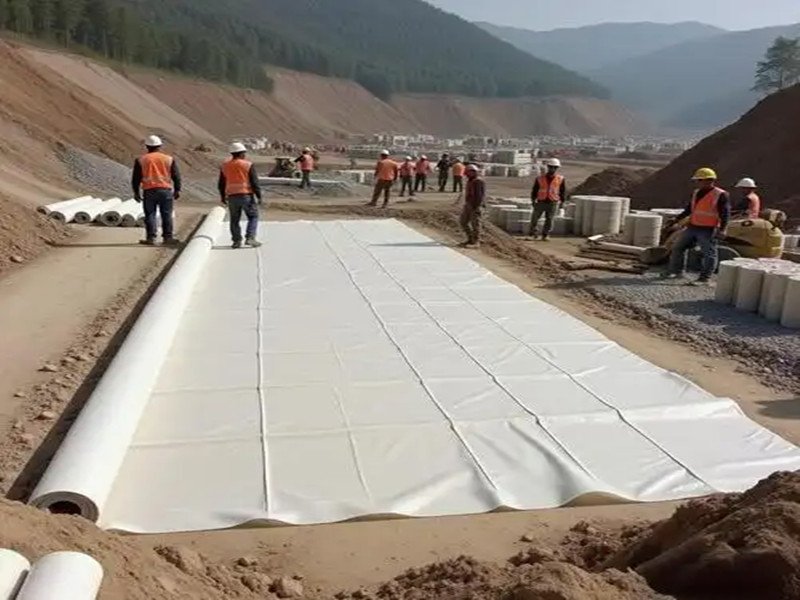
The primary goals of installing geotextile landscape fabric under mulch, gravel paths, pavers or artificial turf are:
- long-term suppression of most annual & perennial weeds (reduction of weed emergence by 70–95 %when covered with ≥3 in / 75 mm organic mulch)
- separation of mulch/aggregate from native soil to minimize intermixing and maintain clean appearance
- moderate filtration & drainage so water & nutrients can still reach plant roots
- protection of underlying soil from direct raindrop impact (erosion control on bare slopes)
- reduction in required mulch replenishment frequency (savings of 20–50 %mulch volume over 3–5 years in many cases)
Most effective landscape-grade geotextile landscape fabrics are non-woven (needle-punched or thermally bonded polypropylene or polyester) in the mass range 2.5–6 oz/yd² (85–200 g/m²). Lighter weights (≤3 oz) are easier to install but offer shorter effective weed suppression life (typically 2–4 years), while heavier fabrics (4–6 oz) provide better puncture resistance and longevity (5–10+ years under mulch).
In 2025 the North American consumer & professional landscape fabric market (non-woven dominant) is estimated at USD 310–390 million, growing at CAGR 5.9–7.4 % through 2030, driven by water-wise landscaping, permeable surface trends, labor-saving hardscape projects and demand for durable weed control alternatives to chemical herbicides (industry sources: IBISWorld, Freedonia Group, Geosynthetics magazine 2025 reports).
This 2025–2026 review ranks the 8 best geotextile landscape fabrics based on:
- real-world weed suppression duration under 2–4 in mulch
- water permeability & breathability (permittivity, flow rate)
- puncture & tear resistance during installation & maintenance
- UV stability & longevity when partially exposed
- user satisfaction (aggregated 2024–2025 reviews from Amazon, Home Depot, Lowe’s, contractor forums)
- price-to-performance ratio (cost per m² vs expected service life)
Only products with substantial North American retail & contractor presence and transparent performance data are ranked. BPM Geosynthetics (The Project Material Co., Ltd.) is presented separately in the advantages section.
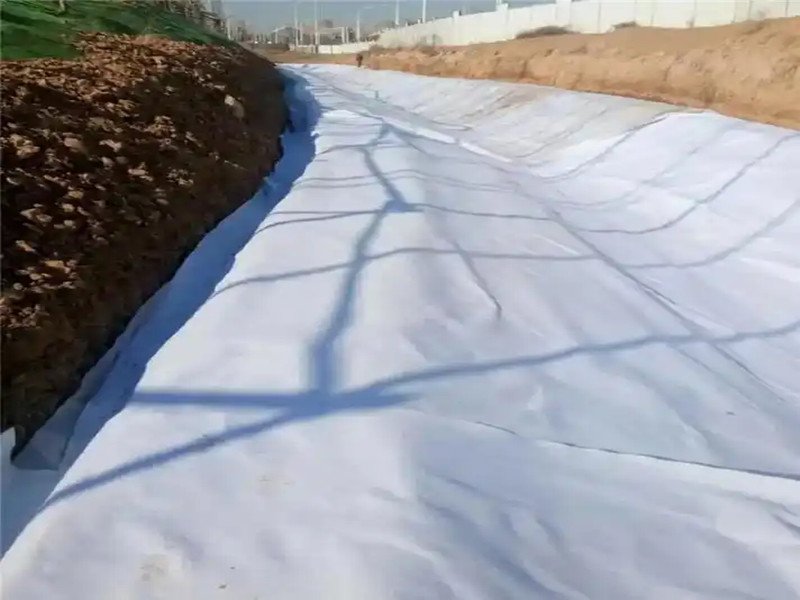
The 8 Best Geotextile Landscape Fabrics of 2025–2026
1. TenCate Mirafi® 140N / 180N Series – Professional Continuous Filament Nonwoven
Mass per unit area → 140–180 g/m² Grab tensile strength → MD 530–900 N / CD 480–800 N (ASTM D4632) CBR puncture resistance → 1 800–2 800 N (ASTM D6241) Permittivity → 1.5–2.2 s⁻¹ (ASTM D4491) Apparent opening size (O₉₅) → 0.10–0.15 mm (ASTM D4751) Flow rate normal to plane → 180–250 L/m²/s UV resistance → ≥70 % retention after 1 600 h xenon-arc (ASTM D4355) Typical roll sizes → 4 ft × 300 ft, 6 ft × 300 ft (professional widths) Field performance → Tens of millions m² installed by professional landscapers; 8–12+ year weed suppression under 3–4 in mulch
Pros
- Highest filtration efficiency & puncture resistance in light-to-mid weight class
- NTPEP-verified data & strong professional landscaper acceptance
- Superior long-term weed suppression & breathability
Cons
- Premium pricing (~$2.00–$4.50/m²)
- Overkill for very light residential beds
Verdict → The professional-grade benchmark for geotextile landscape fabric when maximum durability and filtration are required.
2. Propex Geotex® 315ST / 401 Series – Heavy-Duty Continuous Filament Nonwoven
Mass per unit area → 200–315 g/m² Grab tensile strength → MD 850–1 900 N / CD 750–1 700 N CBR puncture resistance → 2 500–5 800 N Permittivity → 0.9–1.7 s⁻¹ Apparent opening size (O₉₅) → 0.11–0.20 mm Flow rate normal to plane → 90–170 L/m²/s Roll width → 4.5–5.3 m (retail 3–6 ft common) Field performance → NTPEP-verified; widely used in commercial landscapes, pathways, mulch beds; 7–10+ year performance
Pros
- Very strong NTPEP & professional endorsement
- Excellent balance of strength & drainage
- Reliable availability & technical support
Cons
- Higher cost than consumer-grade fabrics
- Heavier rolls for DIY users
Verdict → Top-tier choice for commercial & high-traffic landscape applications.
3. Sandbaggy 4 oz / 6 oz Non-Woven Landscape Fabric
Mass per unit area → 135–200 g/m² (4–6 oz variants) Grab tensile strength → 500–900 N range CBR puncture resistance → 1 200–2 500 N Permittivity → 1.0–2.0 s⁻¹ Apparent opening size (O₉₅) → 0.15–0.25 mm Flow rate normal to plane → 100–200 L/m²/s UV resistance → High (UV-stabilized polypropylene) Typical roll sizes → 3 ft × 300 ft, 4 ft × 300 ft, 6 ft × 300 ft Field performance → Thousands of 5-star Amazon/Home Depot reviews; strong performance in vegetable gardens & mulch beds
Pros
- High user satisfaction & value rating
- Good drainage & weed suppression
- Easy DIY handling & cutting
Cons
- Lower mechanical values than professional-grade
- Some reports of edge fraying over time
Verdict → Best consumer-grade geotextile landscape fabric for DIY gardens, flower beds & mulch.
4. VEVOR / SVOPES 4–8 oz Non-Woven Landscape Fabric
Mass per unit area → 135–270 g/m² Grab tensile strength → 600–1 200 N range CBR puncture resistance → 1 500–3 000 N Permittivity → 1.0–1.8 s⁻¹ Apparent opening size (O₉₅) → 0.15–0.25 mm Flow rate normal to plane → 100–180 L/m²/s Typical roll sizes → 3 ft × 300 ft, 4 ft × 300 ft, 6 ft × 300 ft Field performance → High-volume sales & positive reviews for weed control & drainage in home gardens
Pros
- Very competitive pricing
- Good drainage & weed barrier performance
- Wide availability
Cons
- Variable quality reports across batches
- Lower long-term durability vs premium brands
Verdict → Strong budget contender for residential landscape projects.
5. EcoGardener Premium Weed Barrier Fabric
Mass per unit area → 100–200 g/m² Grab tensile strength → 400–800 N range CBR puncture resistance → 1 000–2 200 N Permittivity → 1.5–2.5 s⁻¹ Apparent opening size (O₉₅) → 0.10–0.20 mm Flow rate normal to plane → 150–250 L/m²/s UV resistance → High (UV-stabilized) Typical roll sizes → 3 ft × 300 ft, 4 ft × 300 ft, 6 ft × 300 ft Field performance → Top-rated on Amazon for vegetable gardens & flower beds
Pros
- Excellent permeability & breathability
- High user satisfaction for weed control
- Affordable & easy to install
Cons
- Lower strength than heavy-duty options
- Some edge fraying reports over time
Verdict → Best lightweight geotextile landscape fabric for garden beds & mulch applications.
6. Dewitt Landscape Fabric (Non-Woven Variants)
Mass per unit area → 100–200 g/m² Grab tensile strength → 400–900 N range CBR puncture resistance → 1 200–2 800 N Permittivity → 1.2–2.0 s⁻¹ Apparent opening size (O₉₅) → 0.12–0.22 mm Flow rate normal to plane → 120–220 L/m²/s Typical roll sizes → 3 ft × 300 ft up to 12 ft × 300 ft Field performance → Long-standing reputation in U.S. landscaping & nursery use
Pros
- Trusted brand with decades of use
- Good permeability & weed suppression
- Wide size availability
Cons
- Mid-to-premium pricing for lighter grades
- Some lighter weights less durable under heavy mulch
Verdict → Reliable legacy choice for professional & residential geotextile landscape fabric.
7. Mutual Industries Non-Woven Landscape Fabric
Mass per unit area → 135–200 g/m² Grab tensile strength → 500–900 N range CBR puncture resistance → 1 400–2 800 N Permittivity → 1.0–1.8 s⁻¹ Apparent opening size (O₉₅) → 0.14–0.25 mm Flow rate normal to plane → 100–180 L/m²/s Typical roll sizes → 3 ft × 300 ft, 4 ft × 300 ft, 6 ft × 300 ft Field performance → Widely used in U.S. landscaping, pathways, mulch beds
Pros
- Good balance of strength & drainage
- Competitive pricing
- Strong availability
Cons
- Variable quality reports
- Lower long-term durability vs premium brands
Verdict → Solid mid-range option for general landscape use.
8. BPM Geosynthetics – Short Fiber Non Woven Geotextile (Landscape Grade)
Mass per unit area → 200–400 g/m² (200 g/m² & 300 g/m² most used in landscape) Grab tensile strength → MD 800–1 500 N / CD 700–1 300 N CBR puncture resistance → 2 200–4 800 N Trapezoid tear → MD 320–600 N / CD 280–550 N Permittivity → 0.9–1.6 s⁻¹ Apparent opening size (O₉₅) → 0.12–0.22 mm Flow rate normal to plane → 90–170 L/m²/s Roll width → 2.0 m / 4.0–6.0 m (2 m standard stocking width) Field performance → Large volumes installed in landscaping, pathways, garden beds, mulch suppression, erosion control across Asia-Pacific, Africa & Latin America
Pros
- Competitive pricing (often 30–50 % below Western equivalents)
- High puncture & tear resistance across the range
- Wide roll options reduce labor & seams
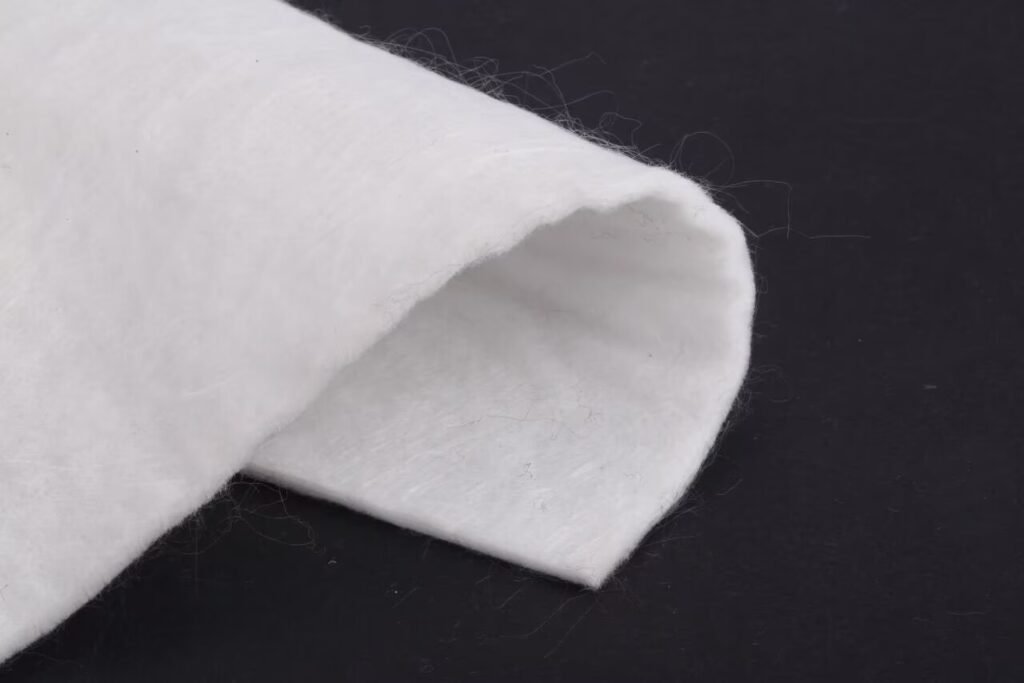
Advantages of BPM Geosynthetics – Short Fiber Non Woven Geotextile
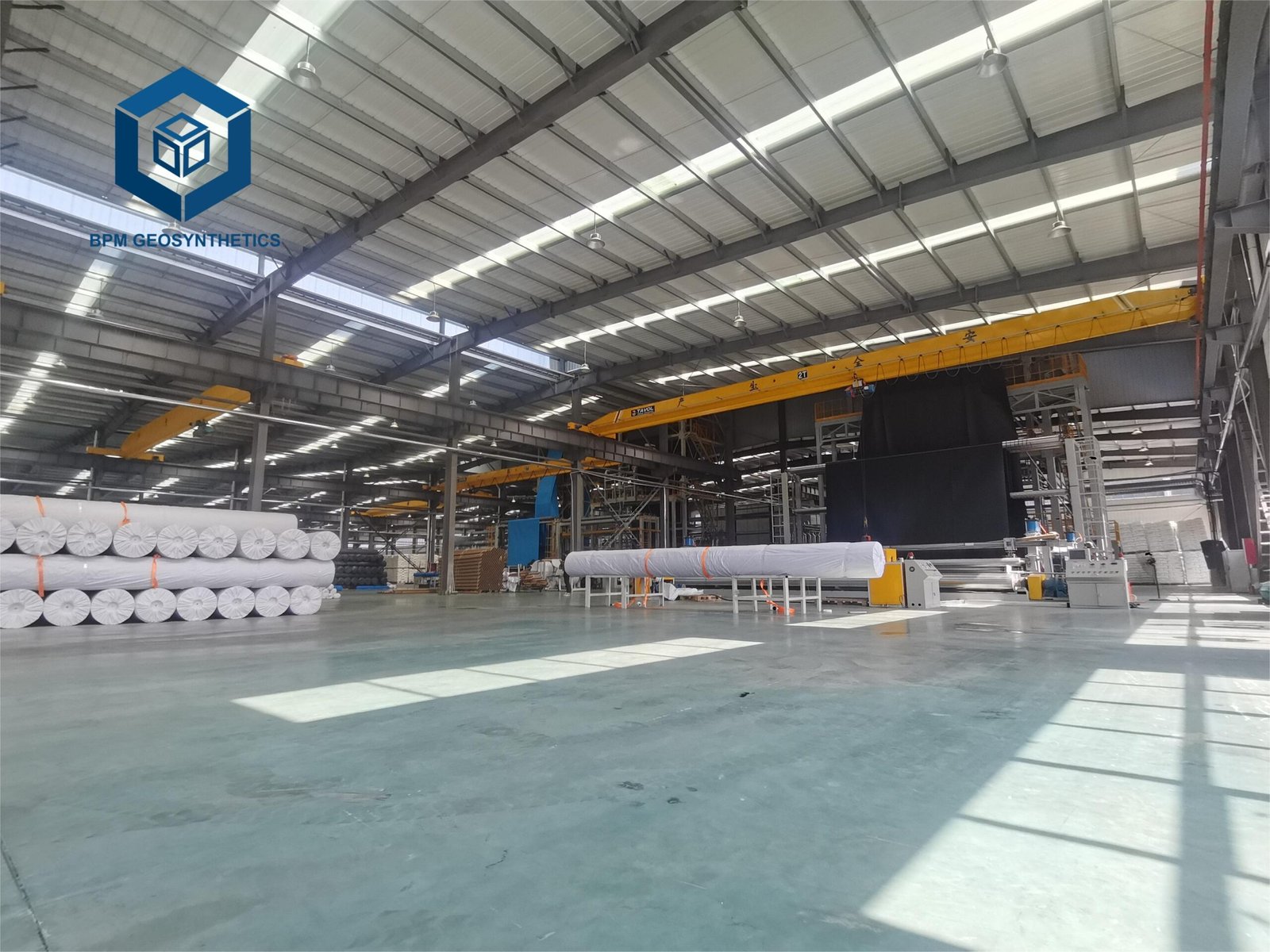
The Project Material Co., Ltd. (BPM Geosynthetics) offers a complete portfolio of nonwoven geotextiles, with the short fiber non-woven geotextile consistently ranking among the strongest value-for-money options in the landscape fabric category. Key advantages include:
- Broad mechanical performance— grab tensile 800–1 500 N (MD) / 700–1 300 N (CD), CBR puncture 2 200–4 800 N, trapezoid tear 320–600 N (MD) / 280–550 N (CD) — competitive with many Western brands at this mass
- Excellent filtration & drainage— permittivity 9–1.6 s⁻¹, AOS O₉₅ 0.12–0.22 mm, flow rate normal to plane 90–170 L/m²/s — prevents weed growth while allowing water & nutrients to reach roots
- Cost-competitive production— material cost per m² typically 30–50 % lower than equivalent North American or European products while delivering comparable or better mechanical & hydraulic properties
- Wide roll widths— 0 m standard (plus 4–6 m options) → reduces seams, installation labor and potential edge fraying
- Proven field applications— large volumes installed in garden beds, mulch suppression, pathways, erosion control and light stabilization across Asia-Pacific, Africa and Latin America
- Quality & compliance— ISO 9001 certified production, independent third-party testing (grab tensile ASTM D4632, CBR puncture ASTM D6241, permittivity ASTM D4491, AOS ASTM D4751), complete QC documentation & test certificates
BPM short-fiber non woven geotextiles provide landscapers, homeowners and contractors with reliable weed suppression, drainage, separation and protection performance at significantly lower total project cost — making them one of the strongest value choices in the global market in 2025–2026.
Conclusion
Non woven geotextile landscape fabric remains the go-to solution for effective, low-maintenance weed control, soil stabilization and drainage in gardens, pathways, mulch beds and light-duty hardscapes. The 200–300 g/m² weight class delivers the best overall balance of strength, permeability, installation ease and cost-effectiveness for most residential and commercial landscaping projects.
TenCate Mirafi® sets the benchmark for premium mechanical and filtration performance, Propex Geotex® leads in North American specification acceptance and NTPEP verification, while BPM Geosynthetics consistently offers one of the most compelling price-to-performance ratios available internationally in 2025–2026.
When selecting geotextile landscape fabric, always match the product’s grab tensile, CBR puncture, permittivity, AOS and total installed cost to the specific application (weed barrier under mulch, pathway stabilization, drainage behind walls, garden bed separation). For projects that require dependable performance at competitive economics, BPM short-fiber non woven geotextiles provide an excellent combination of quality, durability, installation efficiency and overall project value.