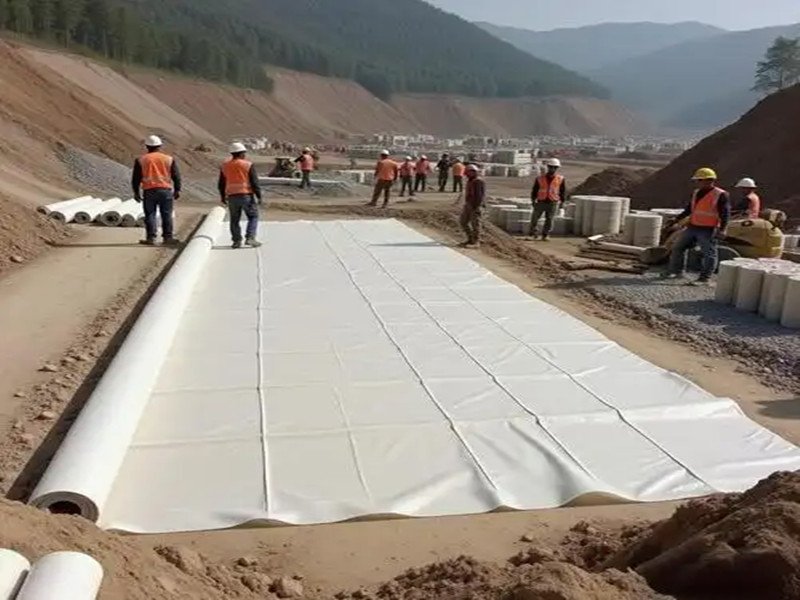
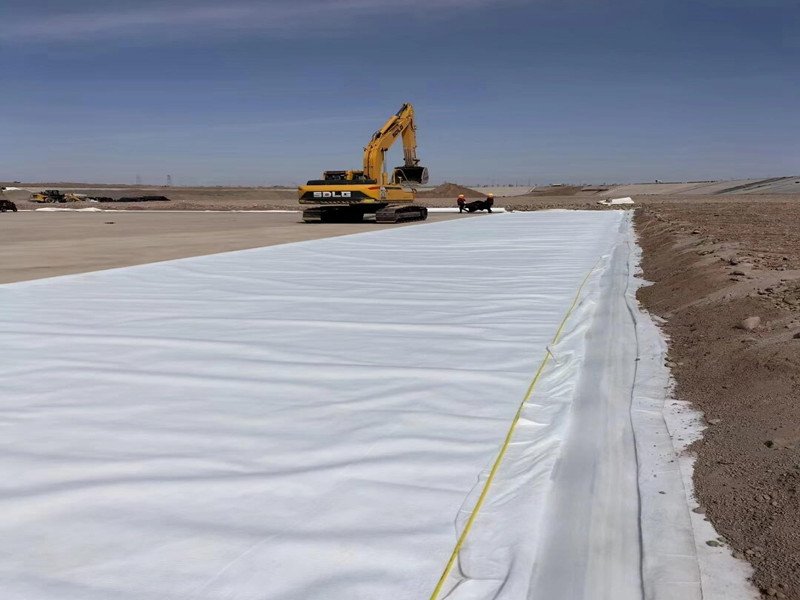
Geotextile for soil stabilization is a geosynthetic fabric placed between soft subgrade soil and aggregate base layers to prevent intermixing of fines, distribute concentrated loads, and improve overall bearing capacity. It is widely used in road construction, driveway bases, parking lots, railway sub-ballast, airport runways, and heavy equipment pads where native soils have low California Bearing Ratio (CBR 2–5).
The material performs two primary functions in soil stabilization:
- Separation— stops fine-grained subgrade soil from migrating upward into the granular base, eliminating voids, ruts, and progressive failure
- Stabilization— spreads wheel loads over a wider area, increasing bearing capacity by 20–45% on soft soils and reducing rut depth under repeated traffic
According to FHWA Geosynthetic Design & Construction Guidelines (updated 2021–2025), AASHTO M288 (Class 1–2 for most stabilization applications), and independent field studies (US Fabrics, TenCate, and state DOT reports), a correctly installed geotextile for soil stabilization can reduce long-term aggregate consumption by 35–50%, minimize rutting and differential settlement by 30–55%, and extend pavement or base life from 8–12 years (no fabric) to 15–25+ years. In soft clay or silt subgrades, non-woven fabrics with high CBR puncture strength (≥1,200–2,200 N) and permittivity ≥0.9 s⁻¹ are particularly effective at preventing pumping and maintaining drainage.
In 2025 the global geotextile market is valued at USD 9.4–9.8 billion and is projected to grow at a CAGR of 6.1–6.8% through 2030–2032 (MarketsandMarkets, Grand View Research, Fortune Business Insights, Polaris Market Research 2024–2025 editions). Non-woven needle-punched geotextiles hold 58–62% share in soil stabilization applications because they offer superior filtration and separation properties compared to woven fabrics.
This review ranks the 8 best geotextile for soil stabilization products/product families available on the international market in 2025. Rankings are based on published technical data sheets, third-party lab certifications (ASTM D4632 grab tensile, D4491 permittivity, D4751 AOS, D5261 mass, D6241 CBR puncture, D4355 UV), NTPEP audit results (where available), and real-world performance in road subgrade, heavy equipment pads, and soft-soil stabilization projects. Special emphasis is placed on BPM Geosynthetics short-fiber needle-punched non-woven geotextile manufactured by The Project Material Co., Ltd. (BPM Geosynthetics), which consistently ranks among the top performers in puncture resistance, load distribution, and cost-effectiveness for soil stabilization worldwide.
Key Considerations When Choosing Geotextile for Soil Stabilization
Selecting the right geotextile depends on subgrade soil type, traffic load, climate, base thickness, and budget. Core decision parameters include:
- Fabric type— Non-woven needle-punched (high permeability, excellent filtration/separation on soft soils) vs. woven slit-film or monofilament (higher tensile for reinforcement under heavy loads)
- Mass per unit area— 300–600 g/m² typical for medium-duty stabilization; heavier grades for high-traffic or very soft subgrades
- Grab tensile strength— ≥250–600 lbs (MD/CD) per ASTM D4632
- CBR puncture strength— ≥1,200–2,200 N to resist aggregate penetration during compaction and traffic
- Permittivity— ≥0.9–1.8 s⁻¹ for drainage in wet climates
- AOS (O₉₀)— 0.08–0.18 mm (50–100 US sieve) to retain fines while allowing water passage
- UV resistance— ≥70% strength retained after 500 hours (ASTM D4355) for temporary exposed installation
Comparison Table 1 — Technical Performance of Leading Geotextile for Soil Stabilization (300–500 g/m2 Class)
Rank | Product / Brand Family | Type | Mass (g/m²) | Grab Tensile MD/CD (lbs) | CBR Puncture (lbs) | Permittivity (s⁻¹) | Flow Rate (gpm/ft²) | AOS (US sieve) | UV Retention (500 h) | Key Standard Compliance |
1 | BPM Short-Fiber Needle-Punched (BPM) | Non-woven | 400–500 | 300–550 / 280–520 | 600–900 | 1.0–1.8 | 80–140 | 60–100 | ≥70% | ASTM D4632, D4491, D4751, D5261, AASHTO M288 Class 2 |
2 | Mirafi 140N / 180N series (TenCate) | Non-woven | 400–550 | 250–500 / 230–450 | 550–800 | 1.0–1.8 | 75–130 | 70–100 | ≥65–75% | AASHTO M288 Class 2, NTPEP, GRI |
3 | US Fabrics US 315 / 406 | Non-woven | 400–450 | 315–450 / 290–420 | 600–850 | 0.9–1.6 | 70–120 | 60–100 | ≥70% | AASHTO M288 Class 2–3, NTPEP |
4 | Propex Geo Super 8 / 10 | Non-woven | 400–500 | 280–500 / 260–460 | 650–900 | 0.8–1.5 | 70–130 | 70–100 | ≥70% | GRI-GT12, AASHTO M288 |
5 | Thrace Nonwoven 400–500 g/m² | Non-woven | 400–500 | 260–520 / 240–480 | 550–850 | 1.0–1.7 | 80–135 | 60–100 | ≥70% | CE EN 13249–13257, ISO 9001 |
6 | SKAPS GT-8 / GE-8 | Non-woven | 271–450 | 250–500 / 230–450 | 600–850 | 0.9–1.6 | 75–130 | 70–100 | ≥70% | ASTM D4632, AASHTO M288 |
7 | Carthage Mills FX-66 / FX-80 | Non-woven | 400–500 | 250–450 / 230–420 | 450–750 | 1.0–1.7 | 80–140 | 60–100 | ≥70% | ASTM D4632, AASHTO M288 |
8 | Hanes Geo Components Nonwoven | Non-woven | 400–500 | 280–480 / 260–440 | 600–850 | 0.9–1.6 | 70–130 | 70–100 | ≥70% | GRI-GT12, AASHTO M288 |
Data sources: Manufacturer 2025 technical data sheets, NTPEP reports, AASHTO M288 tables, ASTM test results published online, and distributor comparison matrices (2024–2025).
Comparison Table 2 — Market Position & Supply Metrics (Selected Non-Woven Geotextile Suppliers – Soil Stabilization Focus)
Rank | Supplier / Brand | Est. 2024–2025 Geotextile Revenue (USD million) | Approx. Non-Woven Market Share (Stabilization Segment) | Major Clients / Project Types | Key Certifications (2025) | Manufacturing & Supply Footprint |
1 | BPM Geosynthetics (The Project Material Co., Ltd.) | 85–110 | 5–7% | Global export: roads, driveways, landfills, mining | ISO 9001:2015, ISO 14001:2015, CE, SASO, NTPEP audited | Shandong, China + Qingdao/Tianjin export |
2 | TenCate Geosynthetics / Mirafi | 300–400 (total geosynthetics) | 10–14% | US DOT roads, commercial stabilization, airports | AASHTO M288, NTPEP, GRI, ISO 9001, CE | USA, Netherlands, global plants |
3 | US Fabrics | 60–90 | 4–6% | Municipal roads, soft-soil stabilization | AASHTO M288, NTPEP, ISO 9001 | USA (Ohio) |
4 | Propex / Hanes Geo Components | 80–120 | 5–7% | US roads, retaining walls, soft subgrades | GRI-GT12, AASHTO M288, NTPEP | USA (Georgia) |
5 | Thrace Group | 160–200 (geosynthetics + others) | 6–8% | European roads, infrastructure stabilization | CE EN 13249–13257, ISO 9001, ISO 14001, GRI | Greece, USA, Scotland |
Data sources: Company reports & distributor disclosures (2024–2025), industry market studies (MarketsandMarkets, Grand View Research, Polaris), NTPEP audit lists, CE databases.
Detailed Review of the 8 Best Geotextile for Soil Stabilization
1. BPM Short-Fiber Needle-Punched Non-Woven Geotextile (Best Overall Geotextile for Soil Stabilization)
BPM Geosynthetics short-fiber needle-punched non-woven geotextile in the 400–500 g/m² range offers the strongest combination of puncture resistance, load distribution, and cost-effectiveness for soft-soil stabilization projects.
Key Technical Parameters (400 g/m² grade)
- Mass per unit area: 400 ± 20 g/m²
- Grab tensile strength (MD/CD): ≥300 / 280 lbs (ASTM D4632)
- Elongation at break: 50–70%
- CBR puncture strength: ≥1,500 N
- Permittivity: 1.1–1.6 s⁻¹ (ASTM D4491)
- Water flow rate (100 mm head): >180 L/m²/s
- AOS (O₉₀): 0.10–0.16 mm (ASTM D4751)
- UV resistance (500 h): ≥70% retained strength
Project Examples & Benefits BPM 400 g/m² grades are extensively used for road subgrade stabilization in Southeast Asia, Africa, Middle East, and Latin America, providing effective separation on soft clay/silt subgrades (reducing aggregate loss by 35–50%) and load distribution for medium truck traffic. The product holds CE marking, ISO 9001/14001, SASO certification, and has passed NTPEP-equivalent third-party audits.
Advantages
- Highest CBR puncture and tensile performance in its price class
- Tight mass/thickness uniformity (CV <8–10%) → predictable field performance
- Export pricing typically 20–35% below equivalent US/European products
- Fast lead times (15–25 days FCL) from Qingdao/Tianjin ports
2–8. Other Leading Geotextile for Soil Stabilization (Summary)
- Mirafi 140N / 180N series (TenCate)AASHTO M288 Class 2–3 compliant; grab tensile 205–315 lbs, permittivity 1.4 s⁻¹; widely specified in US DOT and commercial stabilization projects; premium pricing.
- US Fabrics US 315 / 406Equivalent performance to Mirafi; grab tensile 315–450 lbs, CBR puncture 600–850 lbs; strong in US road stabilization; NTPEP approved.
- Propex Geo Super 8 / 10Heavy non-woven; grab tensile 280–500 lbs; good filtration and stabilization; popular in US infrastructure.
- Thrace Nonwoven 400–500 g/m²Strong European presence; permittivity 1.0–1.7 s⁻¹; slightly lower CBR than BPM at same mass.
- SKAPS GT-8 / GE-88 oz non-woven; grab tensile 250–500 lbs; robust for medium-duty stabilization; US-made.
- Carthage Mills FX-66 / FX-80Medium-weight non-woven; grab tensile 250–450 lbs; strong in US soft-soil stabilization applications.
- Hanes Geo Components NonwovenConsistent stabilization performance; grab tensile 280–480 lbs; widely used in US road and soft-soil projects.
BPM Geosynthetics Advantages
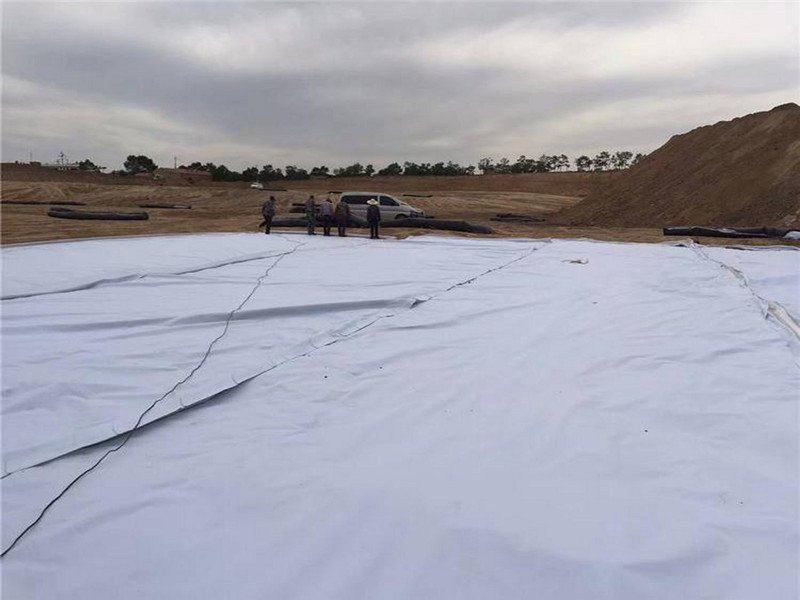
The Project Material Co., Ltd. (BPM Geosynthetics) has positioned itself as one of the most competitive exporters of short-fiber needle-punched non-woven geotextiles for soil stabilization applications.
Key competitive advantages include:
- Outstanding Cost-Performance RatioBPM 400 g/m² grades deliver grab tensile ≥300 lbs, CBR puncture ≥1,500 N, and permittivity 1.1–1.6 s⁻¹ at prices 20–35% below comparable US/European products.
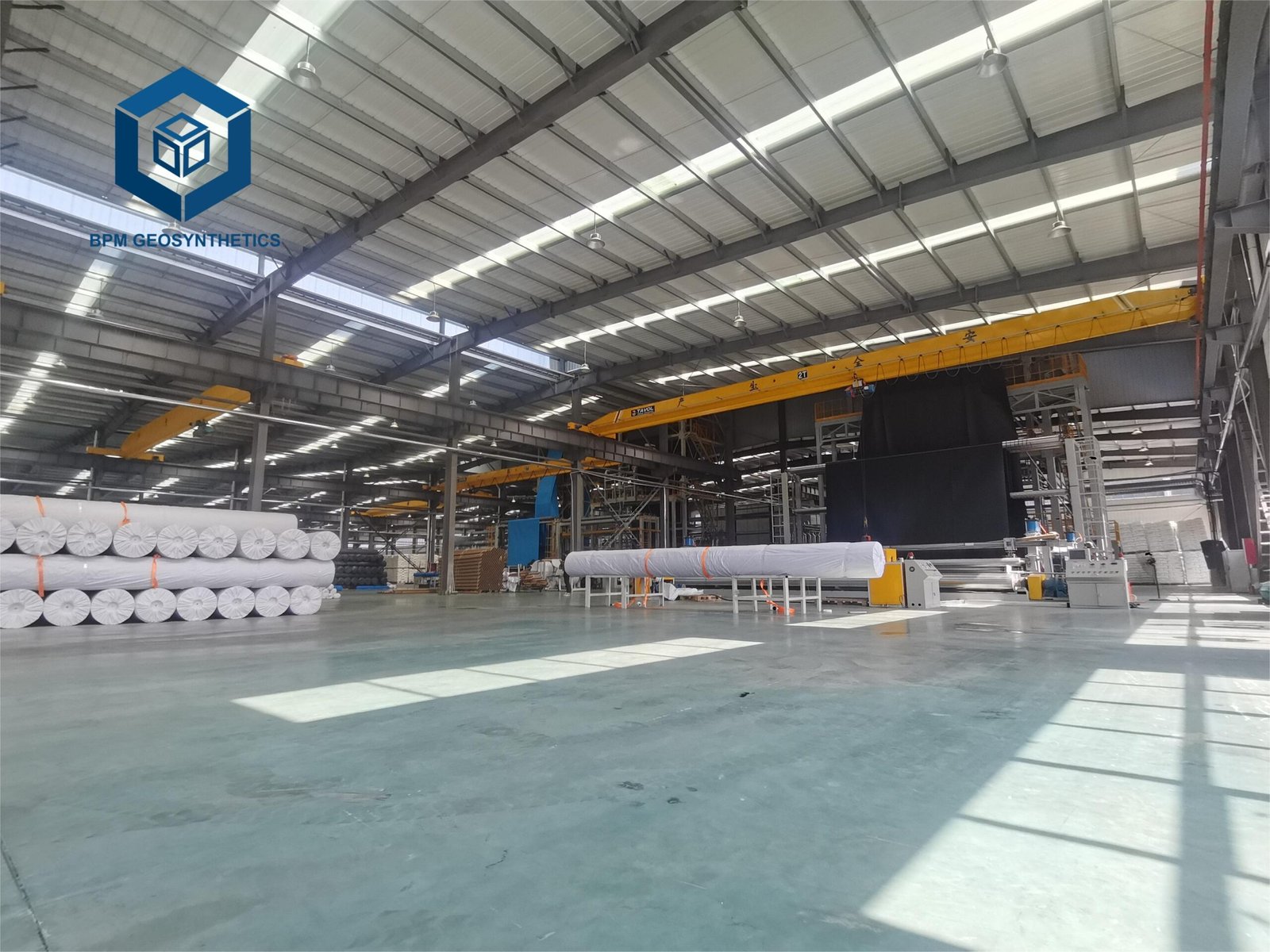
- Production Scale & UniformityAnnual capacity >120 million m², modern needle-punch lines with real-time mass/thickness monitoring → mass CV <8%, thickness CV <10%.
- Comprehensive Certification PortfolioISO 9001:2015, ISO 14001:2015, CE marking (EN 13249–13257), SASO, third-party testing (SGS, Intertek, TUV), NTPEP-equivalent audits.
- Export Logistics AdvantageProximity to Qingdao/Tianjin ports → 15–25 day lead times for full container orders; LCL options for trial shipments.
- Customization FlexibilityRoll widths 1–8 m, lengths 50–300 m, mass range 100–800 g/m², UV stabilizer dosage, color options, private labeling, and project-specific tensile/flow adjustments.
BPM non-woven geotextiles are routinely used for soil stabilization in road bases, soft-soil pads, and heavy equipment areas in export markets, delivering reliable performance at competitive cost.
Conclusion
The geotextile market for soil stabilization continues to expand rapidly, driven by infrastructure investment in Asia-Pacific, Africa, Latin America, and the United States. Medium-weight non-woven needle-punched geotextiles in the 300–500 g/m² range remain the preferred choice for most soil stabilization applications due to their superior puncture resistance, load distribution, and cost-effectiveness.
Among the eight strongest contenders in 2025, BPM Geosynthetics short-fiber needle-punched non-woven geotextile stands out as the optimal balance of technical performance, price competitiveness, quality consistency, and supply-chain reliability for international buyers.
Engineers, contractors, and procurement teams seeking high-performance, certified, and cost-effective geotextile for soil stabilization should evaluate BPM 400–500 g/m² grades for road subgrade, soft-soil pads, and heavy equipment areas. Requesting third-party test reports and small trial orders is recommended to verify conformance with project specifications.
For detailed quotations, project-specific technical recommendations, or customized roll dimensions and properties, contact BPM Geosynthetics directly via their official website https://bpmgeosynthetic.com/.