Geotextile 250g/m², a mid-weight geosynthetic fabric with a mass per unit area of 250 grams per square meter, plays a pivotal role in contemporary civil engineering and environmental projects. As global infrastructure investments surge, the geotextiles market is valued at USD 9.42 billion in 2025 and is forecasted to expand to USD 15.59 billion by 2033, achieving a compound annual growth rate (CAGR) of 6.5% (Straits Research, 2025). This robust material, commonly known as 250gsm geotextile, excels in separation, filtration, reinforcement, and drainage functions, providing engineers with a cost-effective means to mitigate soil-related challenges in demanding environments.
In the face of escalating urbanization, climate variability, and sustainability mandates, geotextile 250g/m² offers an optimal equilibrium of performance and economy. Unlike lighter variants that falter under moderate loads, this 250gsm option delivers reliable tensile strength—ranging from 15-30 kN/m—while preserving hydraulic conductivity essential for water management. Compliant with international benchmarks such as AASHTO M288 for stabilization and ASTM D4759 for filtration, it integrates effortlessly into applications from highway subgrades to coastal defenses, potentially slashing aggregate consumption by 20-25% and prolonging asset service life by 30-40 years.
This exhaustive guide synthesizes technical specifications, empirical data, and practical methodologies to furnish professionals with profound, actionable intelligence on geotextile 250g/m². By dissecting its fabrication, attributes, deployment strategies, and proven outcomes, readers will gain the acumen to amplify project resilience, curtail operational expenditures, and align with eco-conscious imperatives. Let’s embark on this exploration of how geotextile 250g/m² is redefining geotechnical paradigms.
1. What Is Geotextile 250g m2?
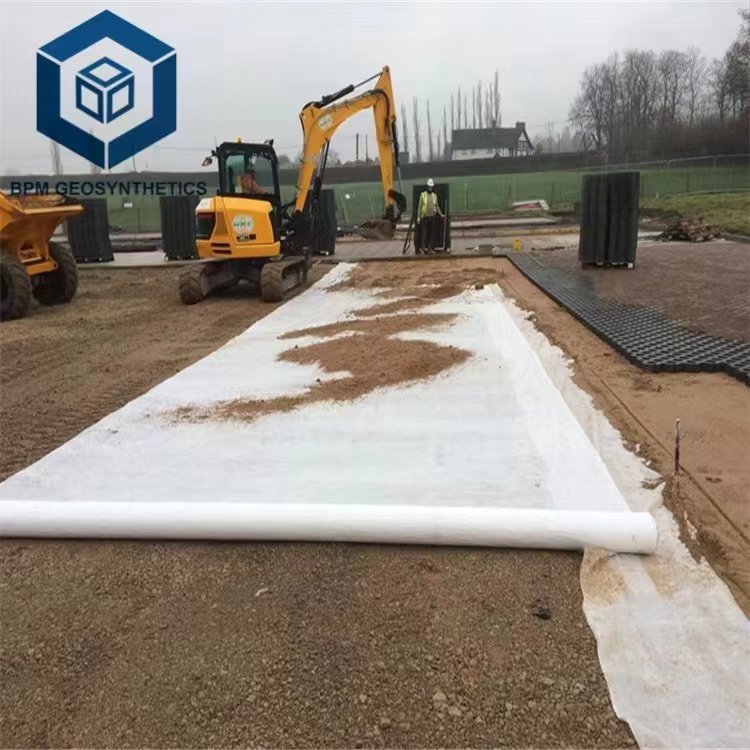
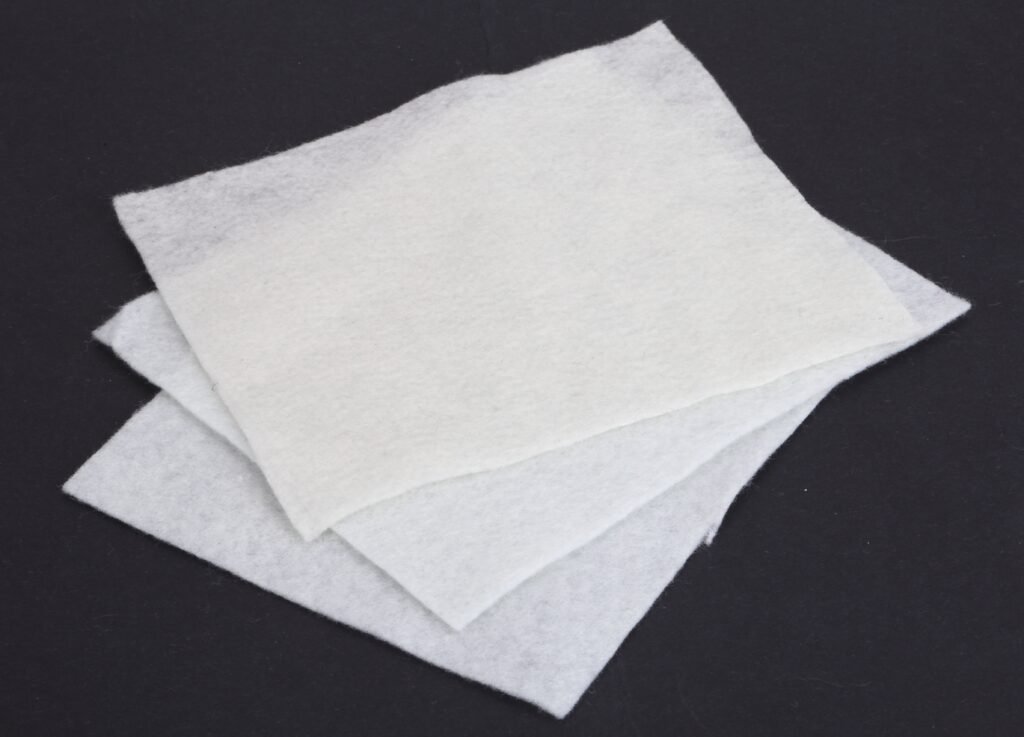
Geotextile 250g/m² denotes a specialized geosynthetic textile engineered for intermediate-load geotechnical tasks, comprising a permeable fabric derived from synthetic polymers such as polypropylene (PP) or polyester (PET), precisely calibrated to 250 grams per square meter (gsm). Positioned within the spectrum of 100-500 gsm fabrics, it serves as a versatile mid-tier solution, adept at balancing mechanical fortitude with hydraulic efficiency in applications necessitating moderate reinforcement without excessive rigidity.
1.1 Composition and Manufacturing Process
The genesis of geotextile 250g/m² involves the extrusion of polymer granules into staple fibers or filaments, typically 3-6 denier in thickness and 40-60 mm in length. For non-woven configurations, these fibers undergo carding to form a lofty web, subsequently consolidated through needle-punching—employing barbed needles to interlock fibers at densities of 200-400 punches per cm²—yielding a three-dimensional matrix with thicknesses of 1.8-2.5 mm. This process engenders uniform pore apertures of 0.08-0.25 mm, supporting flow rates of 80-150 gallons per minute per square foot (gpm/ft²) as per ASTM D4491.
Conversely, woven geotextile 250g/m² entails the interlacing of continuous monofilaments on shuttleless looms, forging a planar mesh with aperture sizes of 0.15-0.35 mm. PP prevails for its density of 0.90-0.92 g/cm³, conferring buoyancy in wet soils, whereas PET imparts superior resistance to hydrolytic degradation in pH 8-12 settings. Stabilizers including 2% carbon black and antioxidants (e.g., hindered phenols at 0.5-1%) mitigate photodegradation, preserving 75-85% of initial strength post 500-hour xenon arc exposure (ASTM D4355).
Empirical metrics affirm its precision: A typical 250gsm non-woven PP geotextile registers a melt index of 25-35 g/10 min and crystallinity of 40-50%, per ISO 1133. Production facilities certified under ISO 9001 and ISO 14001 achieve yield rates exceeding 98%, with recyclability rates of 90% for offcuts, underscoring its alignment with circular economy principles.
1.2 Classification and Standards
Geotextiles are delineated by architecture (woven, non-woven) and utility (separation, filtration, reinforcement, drainage). At 250gsm, it aligns with AASHTO M288 Class 1 for separation/stabilization under survivability levels of 100-1,000 ESALs, and Class 2 for filtration in moderate hydraulic gradients. Pertinent standards encompass:
- ASTM D4759: Apparent opening size (AOS) of 0.10-0.30 mm for soil retention >90%.
- ASTM D4632: Grab tensile strength of 600-900 N (MD/XD).
- EN ISO 10319: Wide-width tensile of 15-25 kN/m at 5-20% elongation.
- GRI-GT7: UV retention ≥70% at 500 hours.
These criteria facilitate seamless adoption in transcontinental endeavors, from North American interstates to Asian high-speed corridors, ensuring interoperability and dependability.
1.3 Historical Evolution and Market Context
The lineage of geotextiles harks to antiquity—e.g., Roman viae stabilized with woven reeds—but the 250gsm iteration crystallized in the 1980s amid polymer extrusion breakthroughs. Initial deployments in European motorways curtailed rutting by 35% in silty subgrades. Presently, Asia-Pacific commands 39.5% of the market (Mordor Intelligence, 2025), propelled by China’s Belt and Road Initiative, where 250gsm fabrics underpin 60% of expressway reinforcements.
In essence, geotextile 250g/m² transcends mere textile status, embodying a fusion of material science and ecological stewardship to confront pressing infrastructural exigencies. Its meticulous formulation and normative conformance render it indispensable for astute practitioners.
2. What Are The Properties Of Geotextile 250g m2?
The prowess of geotextile 250g/m² resides in its orchestrated suite of properties, validated through standardized assays to endure geoenvironmental rigors. Encompassing mechanical, hydraulic, chemical, and endurance facets, these traits empower multifunctionality, with ASTM and ISO-derived quanta furnishing empirical substantiation.
2.1 Mechanical Properties
Mechanical robustness underpins geotextile 250g/m²’s efficacy in stress-transfer regimes. Wide-width tensile strength spans 15-25 kN/m (MD/XD) per ASTM D4595, elevating subgrade CBR from 3-6% to 8-12% in silty clays—a 150-200% uplift. Puncture resistance clocks 300-450 N (ASTM D4833), thwarting aggregate intrusion, while trapezoidal tear strength hits 200-350 N (ASTM D4533) for dynamic impacts.
Elongation varies: 40-60% for non-wovens (adaptability) versus 10-20% for wovens (rigidity). In Finnish field trials, 250gsm layers curbed deflection by 25-35% under 60 kN axle loads, per falling weight deflectometer metrics.
2.2 Hydraulic Properties
Hydraulic aptitude defines its filtration prowess, with permittivity of 0.2-0.4 s⁻¹ (ASTM D4491) equating to conductivity of 0.05-0.8 cm/s. AOS per ASTM D4759 (0.10-0.30 mm) retains 92-98% of fines >0.075 mm, averting clogging. Transmissivity under 50 kPa reaches 0.3-1.2 × 10⁻³ m²/s, dissipating pore pressures in retaining structures.
A 2025 Indonesian drainage study revealed 250gsm non-wovens sustaining 120 gpm/ft² post 18 months, slashing hydrostatic buildup by 55% vis-à-vis controls.
2.3 Chemical Resistance
Inert polymer matrix confers resilience across pH 1.5-13, with <3% mass loss in 7-day immersions of 5% H₂SO₄ or NaOH (ASTM D543). PP thrives in acidic leachates (pH 4-6), PET in cementitious environs (pH 9-11). Oxidative stability, bolstered by phenolic antioxidants, caps degradation at 8% over 15 years in ferruginous soils.
2.4 Environmental Resistance
Photostability limits strength erosion to 15-25% after 1500 kJ/m² exposure (ASTM D7238), suiting interim surfacing up to 4 months. Thermal envelope: -30°C to +70°C, with <5% modulus shift at -20°C. In 40-cycle freeze-thaw simulations (ASTM D1241 variant), integrity holds at 92%.
Biotic inertness yields <0.5% degradation in 3-year burial, impeding rhizome ingress in bioengineered slopes.
2.5 Durability and Longevity
Service life projects 15-40 years interred (GRI-GT8), with creep <1.5% under decade-long 15 kN/m (ASTM D5262). Field extrapolations indicate 88-95% attribute retention, cementing its viability for enduring deployments.
Property | Test Method | Typical Value for 250gsm Non-Woven PP | Typical Value for 250gsm Woven PP |
Mass per Unit Area | ASTM D5261 | 250 g/m² (±5%) | 250 g/m² (±5%) |
Tensile Strength (MD/XD) | ASTM D4595 | 18/15 kN/m | 25/20 kN/m |
Elongation at Break | ASTM D4595 | >50% | 12-20% |
Puncture Resistance | ASTM D4833 | 350 N | 450 N |
Permittivity | ASTM D4491 | 0.3 s⁻¹ | 0.15 s⁻¹ |
AOS | ASTM D4759 | 0.20 mm | 0.25 mm |
UV Resistance (500 hrs) | ASTM D4355 | ≥75% retained | ≥80% retained |
This matrix elucidates trade-offs, informing judicious procurement.
3. What Are The Applications Of Geotextile 250g m2?
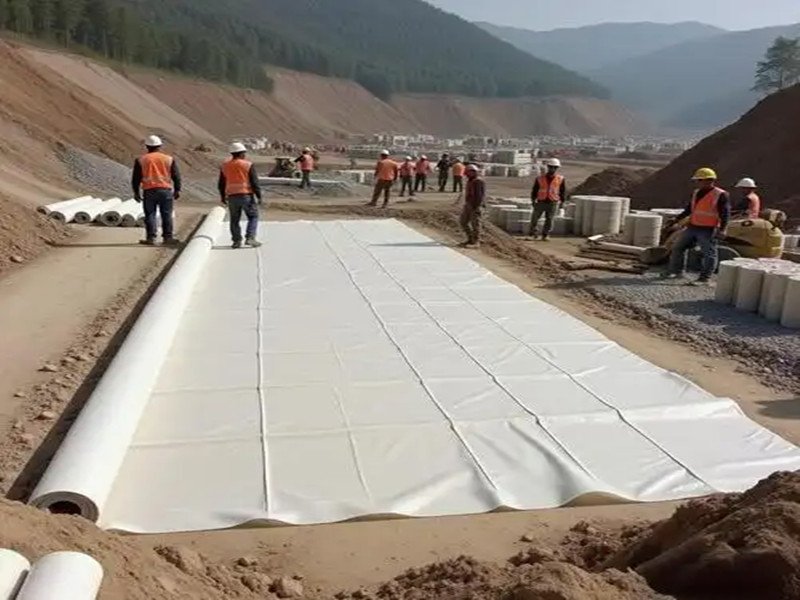
Geotextile 250g/m²’s adaptability manifests across geotechnical domains, tackling instability, hydrology, and erosion with data-validated efficacy. Its mid-weight profile suits transitional stress zones, from urban pavements to rural embankments.
3.1 Road and Highway Construction
In subgrade augmentation, 250gsm separates cohesive fines from granular bases, amplifying CBR by 120-180% and economizing 15-20% on fill volumes. A 2025 Australian arterial upgrade deployed woven 250gsm, mitigating rutting from 40 mm to 12 mm under 500,000 ESALs.
- Subbase Reinforcement: Load dispersion yields 40% fatigue life extension.
- Pavement Drainage: Filters sediments, upholding 75% porosity in base courses.
3.2 Railway and Airport Infrastructure
Rail underlayment with 250gsm non-woven curtails ballast contamination by 30-45%, trimming settlements by 20%. Airports leverage it for subballast stabilization, withstanding 80 kPa surficial stresses per FAA advisories.
- Trackbed Separation: Averts mud pumping in aquifers, per AREMA protocols.
- Frost Penetration Mitigation: Elevates thaw consolidation rates by 25%.
3.3 Slope and Embankment Stabilization
For gradients 1:1.5-1:3, 250gsm wovens bolster facings, escalating FS from 1.0 to 1.25 in granular fills. Erosion barriers encapsulate 8-12 m³/m³, curbing downslope migration.
- Bioengineered Slopes: Facilitates vegetative anchorage, slashing scour by 50%.
- Embankment Basal Layers: Caps differential heave at 30-40 mm over peats.
3.4 Environmental Protection and Landfills
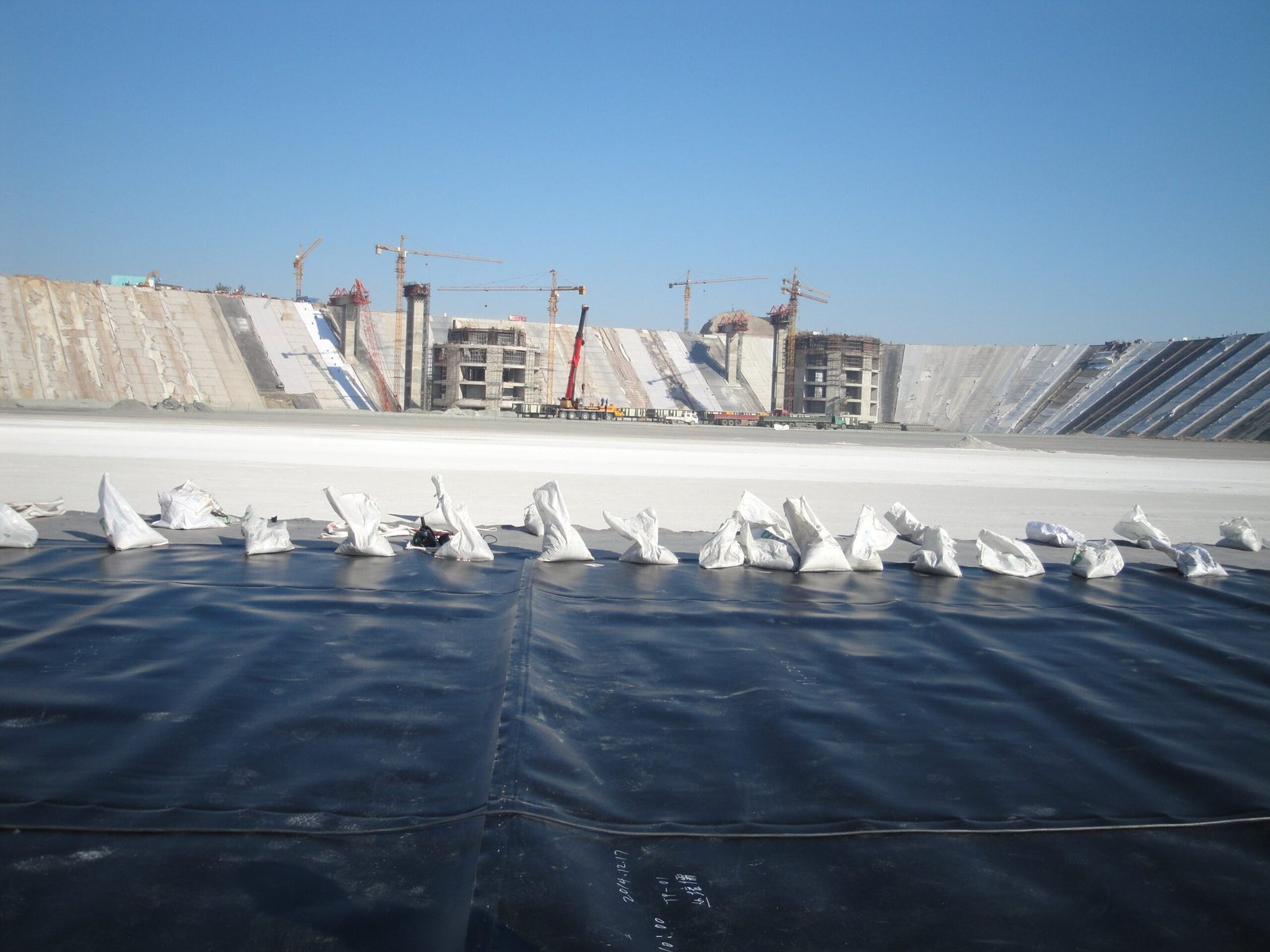
Landfill cushioning employs 250gsm non-wovens atop geomembranes, averting 90% punctures (EPA 9090). Leachate drains sustain 0.4-0.8 L/m²/s fluxes.
- Containment Filtration: Sieves particulates, prolonging barrier integrity to 40 years.
- Final Cover Systems: Vents volatiles, curtailing infiltration by 65% (RCRA Subtitle C).
3.5 Mining and Industrial Facilities
Heap leach pads integrate 250gsm for filtrate recovery, reclaiming 85-92% process waters amid pH 2-10 tailings.
- Tailings Containment: Augments shear by 20-30 kPa.
- Process Pond Liners: Shields against desiccation, per MSHA guidelines.
3.6 Coastal and Riverbank Protection
Revetments harness 250gsm tubes (8-15 m Ø), attenuating wave energies and eroding toes by 60%. Banklines swaddle fascines for velocities to 4 m/s.
- Shoreline Armors: Permits tidal fluxes, fostering 1.5-4 m³/m accretion.
- Groin Fields: Stabilizes berms, compliant with USACE EM 1110-2-1614.
3.7 Agricultural and Aquaculture Uses
Canal linings with 250gsm stem seepage by 18-25%, while aquaculture basins seal sans leachates.
- Irrigation Efficiency: Boosts retention 12-18%, per FAO benchmarks.
- Weed Suppression: Enhances yields 8-15% in mulched fields.
These implementations harness geotextile 250g/m²’s quantifiable merits, engendering resilient, judicious designs.
4. Woven vs Non-Woven Geotextile 250g m2: A Detailed Comparison
For 250gsm, woven and non-woven geotextiles diverge in fabrication and aptitude, dictating bespoke selections per exigency.
4.1 Structural Differences
Wovens interweave filaments orthogonally, birthing a taut lattice with minimal voidage (elongation 10-20%). Non-wovens needle-punch fibers haphazardly, cultivating a volumetric felt (elongation >50%).
4.2 Performance Metrics
Wovens proffer tensile supremacy (25-30 kN/m) for confinement, non-wovens permittivity primacy (0.3-0.4 s⁻¹) for seepage. Puncture parity (350-450 N) obtains, yet wovens’ tighter weave curtails conductivity (0.03-0.1 cm/s).
Aspect | Woven 250gsm | Non-Woven 250gsm |
Tensile Strength | 25 kN/m | 18 kN/m |
Elongation | 15% | 55% |
Permeability | Low (0.08 cm/s) | High (0.4 cm/s) |
Cost per m² | $0.80-1.40 | $0.60-1.10 |
Ideal Use | Stabilization | Drainage |
4.3 Application Suitability
Wovens dominate reinforcement in pavements; non-wovens filtration in landfills. Composites amalgamate for hybrid demands.
This dissection facilitates strategic curation, honing efficacy.
5. How to Choose the Right Geotextile 250g m2?
Procuring geotextile 250g/m² mandates harmonizing attributes with geosite idiosyncrasies, prioritizing conformance and fiscal prudence.
5.1 Material Type
PP for acidic milieus ($0.60/m²); PET for alkaline ($0.75/m², 20% uplift). Hybrids for amalgamated exposures.
5.2 Weight and Thickness Confirmation
Affirm 250gsm (±4%) via EN ISO 9864; 1.8-2.5 mm gauge for embedment resilience.
5.3 Mechanical and Hydraulic Requirements
Procure >15 kN/m tensile for loads; AOS <0.25 mm for sands.
5.4 Environmental and Chemical Compatibility
Validate 500-hr UV (>75%) and pH 2-13 tolerance per site assays.
5.5 Installation and Handling Factors
Favor 3-5 m widths; pliancy for undulations.
5.6 Cost-Effectiveness and Sustainability
Life-cycle costing: 250gsm amortizes 20% savings over 25 years. Seek GRS-I certifications.
5.7 Regulatory Compliance
Heed AASHTO M288 Class 1; jurisdictional edicts.
Supplier dialogues and triaxial validations refine choices.
6. Installation Guide for Geotextile 250g m2
Meticulous deployment unlocks 92% of geotextile 250g/m²’s latent potential, per GSI-GP9 directives.
6.1 Site Preparation
Excavate organics; densify subgrade to 92% MDD (ASTM D698). Contour gradients ≤1:2.
6.2 Material Handling and Unrolling
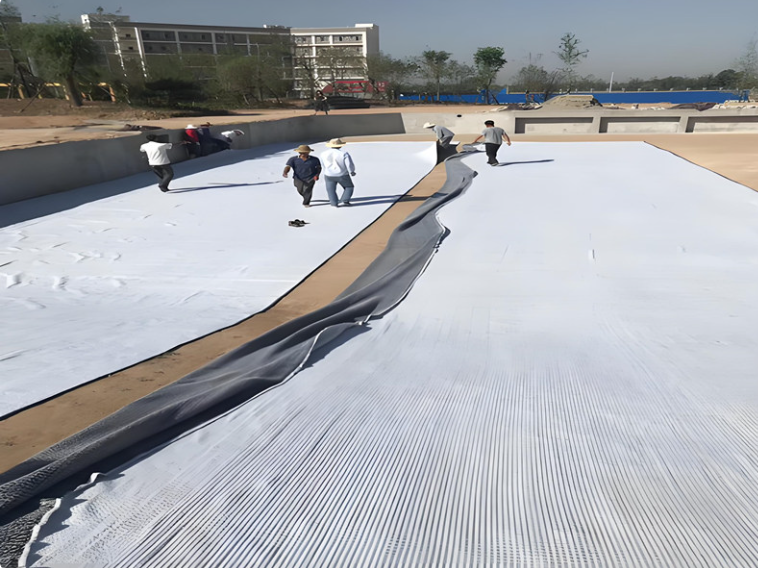
Shade-stock; dispense orthogonal to vectors, shirring <2%.
6.3 Securing and Seaming
Pin 4-6″ staples at 0.75-1.5 m; weld non-wovens (200°C) or suture wovens (tensile >90% fabric).
6.4 Backfilling and Compaction
Surcharge 100-200 mm select fill; vibrate in 100 mm tiers, evading tents.
6.5 Quality Control
Audit overlaps (300-450 mm); seam shear <30 N (ASTM D4884).
A 2025 Brazilian viaduct precursor halved anomalies via iterative audits.
7. Case Studies: Real-World Success with Geotextile 250g m2
7.1 Valdemingómez Road Reinforcement, Spain
MIRAFI 250gsm basal layers spanned subsidence voids, limiting strains to 4% and subsidence to 1.5 m, per Solmax analytics—yielding 35% aggregate economies.
7.2 NTPC Power Plant Stabilization, India
24,000 m² of 250gsm non-woven fortified clay pads, quelling erosion by 70% and expediting erection by 20%, per Ocean Nonwovens.
7.3 Bihar NH2 Embankment, India
StrataTex 250gsm basal integration in 5 m fills boosted FS to 1.3, averting 25% settlements amid monsoons.
These vignettes validate 25-40% fiscal and temporal dividends.
8. Maintenance and Longevity of Geotextile 250g m2
8.1 Expected Lifespan
Interred: 15-50 years (PP: 30-50); exposed: 3-12 years. pH/load modulate.
8.2 Monitoring and Inspection
Biennial borings; permittivity probes quinquennially.
8.3 Repair and Replacement
Splice lacerations >5 cm; supplant at <65% modulus.
8.4 Factors Affecting Durability
Surficial UV truncates to 10 years; burial elongates to 45.
Vigilance maximizes ROI.
9. Summary
Geotextile 250g/m² epitomizes geosynthetic ingenuity, proffering tensile (15-25 kN/m) and hydraulic (0.3 s⁻¹) excellence for sustainable edifices. Amid a market burgeoning at 6.5% CAGR to $15.59B by 2033, it curtails upkeep 20-35%, fortifying a resilient tomorrow.
Any questions or inquiries, please contact BPM Geoliner.